

-
1 сигнализация о состоянии объекта
Russian-English dictionary of telecommunications > сигнализация о состоянии объекта
-
2 состояние объекта
1) Information technology: object state2) Programming: instance state, plant condition, plant status -
3 набор свойств объекта, описывающих его в конкретный момент времени
Information technology: object stateУниверсальный русско-английский словарь > набор свойств объекта, описывающих его в конкретный момент времени
-
4 сигнализация о состоянии объекта
Telecommunications: object state signalingУниверсальный русско-английский словарь > сигнализация о состоянии объекта
-
5 экземпляр объекта (сети и системы связи)
экземпляр объекта (сети и системы связи)
Дескриптор экземпляра класса объекта, который однозначно определяется в пределах домена системы автоматизации подстанции и который имеет очерченные границы и идентичность, инкапсулирует состояния и характер изменения. Примечание. Состояния представлены атрибутами, характер изменения - сервисами и конечными автоматами.
[ ГОСТ Р 54325-2011 (IEC/TS 61850-2:2003)]EN
object, instance
descriptor of an instance of a class of entity that is uniquely identifiable within the SAS domain, with defined boundaries and identity which encapsulates states and behaviour. States are represented by attributes, behaviour by services and state machines
[IEC 61850-2, ed. 1.0 (2003-08)]Тематики
EN
Русско-английский словарь нормативно-технической терминологии > экземпляр объекта (сети и системы связи)
-
6 БИБЛИОГРАФИЯ
Мы приняли следующие сокращения для наиболее часто упоминаемых книг и журналов:IJP - International Journal of Psycho-analysisJAPA - Journal of the American Psychoanalytic AssociationSE - Standard Edition of the Complete Psychological Works of Sigmund Freud, ed. James Strachey (London: Hogarth Press and the Institute of Psycho-Analysis, 1953—74.)PSOC - Psychoanalytic Study of the Child (New Haven: Yale University Press)PQ - Psychoanalytic QuarterlyWAF - The Writings of Anna Freud, ed. Anna Freud (New York: International Universities Press, 1966—74)PMC - Psychoanalysis The Major Concepts ed. Burness E. Moore and Bernard D. Fine (New Haven: Yale University Press)\О словаре: _about - Psychoanalytic Terms and Concepts\1. Abend, S. M. Identity. PMC. Forthcoming.2. Abend, S. M. (1974) Problems of identity. PQ, 43.3. Abend, S. M., Porder, M. S. & Willick, M. S. (1983) Borderline Patients. New York: Int. Univ. Press.4. Abraham, K. (1916) The first pregenital stage of libido. Selected Papers. London, Hogarth Press, 1948.5. Abraham, K. (1917) Ejaculatio praecox. In: selected Papers. New York Basic Books.6. Abraham, K. (1921) Contributions to the theory of the anal character. Selected Papers. New York: Basic Books, 1953.7. Abraham, K. (1924) A Short study of the development of the libido, viewed in the light of mental disorders. In: Selected Papers. London: Hogarth Press, 1927.8. Abraham, K. (1924) Manic-depressive states and the pre-genital levels of the libido. In: Selected Papers. London: Hogarth Press, 1949.9. Abraham, K. (1924) Selected Papers. London: Hogarth Press, 1948.10. Abraham, K. (1924) The influence of oral erotism on character formation. Ibid.11. Abraham, K. (1925) The history of an impostor in the light of psychoanalytic knowledge. In: Clinical Papers and Essays on Psychoanalysis. New York: Basic Books, 1955, vol. 2.12. Abrams, S. (1971) The psychoanalytic unconsciousness. In: The Unconscious Today, ed. M. Kanzer. New York: Int. Univ. Press.13. Abrams, S. (1981) Insight. PSOC, 36.14. Abse, D W. (1985) The depressive character In Depressive States and their Treatment, ed. V. Volkan New York: Jason Aronson.15. Abse, D. W. (1985) Hysteria and Related Mental Disorders. Bristol: John Wright.16. Ackner, B. (1954) Depersonalization. J. Ment. Sci., 100.17. Adler, A. (1924) Individual Psychology. New York: Harcourt, Brace.18. Akhtar, S. (1984) The syndrome of identity diffusion. Amer. J. Psychiat., 141.19. Alexander, F. (1950) Psychosomatic Medicine. New York: Norton.20. Allen, D. W. (1974) The Feat- of Looking. Charlottesvill, Va: Univ. Press of Virginia.21. Allen, D. W. (1980) Psychoanalytic treatment of the exhibitionist. In: Exhibitionist, Description, Assessment, and Treatment, ed. D. Cox. New York: Garland STPM Press.22. Allport, G. (1937) Personality. New York: Henry Holt.23. Almansi, R. J. (1960) The face-breast equation. JAPA, 6.24. Almansi, R. J. (1979) Scopophilia and object loss. PQ, 47.25. Altman, L. Z. (1969) The Dream in Psychoanalysis. New York: Int. Univ. Press.26. Altman, L. Z. (1977) Some vicissitudes of love. JAPA, 25.27. American Psychiatric Association. (1987) Diagnostic and Statistical Manual of Mental Disorders, 3d ed. revised. Washington, D. C.28. Ansbacher, Z. & Ansbacher, R. (1956) The Individual Psychology of Alfred Adler. New York: Basic Books.29. Anthony, E. J. (1981) Shame, guilt, and the feminine self in psychoanalysis. In: Object and Self, ed. S. Tuttman, C. Kaye & M. Zimmerman. New York: Int. Univ. Press.30. Arlow. J. A. (1953) Masturbation and symptom formation. JAPA, 1.31. Arlow. J. A. (1959) The structure of the deja vu experience. JAPA, 7.32. Arlow. J. A. (1961) Ego psychology and the study of mythology. JAPA, 9.33. Arlow. J. A. (1963) Conflict, regression and symptom formation. IJP, 44.34. Arlow. J. A. (1966) Depersonalization and derealization. In: Psychoanalysis: A General Psychology, ed. R. M. Loewenstein, L. M. Newman, M. Schur & A. J. Solnit. New York: Int. Univ. Press.35. Arlow. J. A. (1969) Fantasy, memory and reality testing. PQ, 38.36. Arlow. J. A. (1969) Unconscious fantasy and disturbances of mental experience. PQ, 38.37. Arlow. J. A. (1970) The psychopathology of the psychoses. IJP, 51.38. Arlow. J. A. (1975) The structural hypothesis. PQ, 44.39. Arlow. J. A. (1977) Affects and the psychoanalytic situation. IJP, 58.40. Arlow. J. A. (1979) Metaphor and the psychoanalytic situation. PQ, 48.41. Arlow. J. A. (1979) The genesis of interpretation. JAPA, 27 (suppl.).42. Arlow. J. A. (1982) Problems of the superego concept. PSOC, 37.43. Arlow. J. A. (1984) Disturbances of the sense of time. PQ, 53.44. Arlow. J. A. (1985) Some technical problems of countertransference. PQ, 54.45. Arlow, J. A. & Brenner, C. (1963) Psychoanalytic Concepts and the Structural Theory, New York: Int. Univ. Press.46. Arlow, J. A. & Brenner, C. (1969) The psychopathology of the psychoses. IJP, 50.47. Asch, S. S. (1966) Depression. PSOC, 21.48. Asch, S. S. (1976) Varieties of negative therapeutic reactions and problems of technique. JAPA, 24.49. Atkins, N. (1970) The Oedipus myth. Adolescence, and the succession of generations. JAPA, 18.50. Atkinson, J. W. & Birch, D. (1970) The Dynamics of Action. New York: Wiley.51. Bachrach, H. M. & Leaff, L. A. (1978) Analyzability. JAPA, 26.52. Bacon, C. (1956) A developmental theory of female homosexuality. In: Perversions,ed, S. Lorand & M. Balint. New York: Gramercy.53. Bak, R. C. (1953) Fetishism. JAPA. 1.54. Bak, R. C. (1968) The phallic woman. PSOC, 23.55. Bak, R. C. & Stewart, W. A. (1974) Fetishism, transvestism, and voyeurism. An American Handbook of Psychiatry, ed. S. Arieti. New York: Basic Books, vol. 3.56. Balint, A. (1949) Love for mother and mother-love. IJP, 30.57. Balter, L., Lothane, Z. & Spencer, J. H. (1980) On the analyzing instrument, PQ, 49.58. Basch, M. F. (1973) Psychoanalysis and theory formation. Ann. Psychoanal., 1.59. Basch, M. F. (1976) The concept of affect. JAPA, 24.60. Basch, M. F. (1981) Selfobject disorders and psychoanalytic theory. JAPA, 29.61. Basch, M. F. (1983) Emphatic understanding. JAPA. 31.62. Balldry, F. Character. PMC. Forthcoming.63. Balldry, F. (1983) The evolution of the concept of character in Freud's writings. JAPA. 31.64. Begelman, D. A. (1971) Misnaming, metaphors, the medical model and some muddles. Psychiatry, 34.65. Behrends, R. S. & Blatt, E. J. (1985) Internalization and psychological development throughout the life cycle. PSOC, 40.66. Bell, A. (1961) Some observations on the role of the scrotal sac and testicles JAPA, 9.67. Benedeck, T. (1949) The psychosomatic implications of the primary unit. Amer. J. Orthopsychiat., 19.68. Beres, C. (1958) Vicissitudes of superego functions and superego precursors in childhood. FSOC, 13.69. Beres, D. Conflict. PMC. Forthcoming.70. Beres, D. (1956) Ego deviation and the concept of schizophrenia. PSOC, 11.71. Beres, D. (1960) Perception, imagination and reality. IJP, 41.72. Beres, D. (1960) The psychoanalytic psychology of imagination. JAPA, 8.73. Beres, D. & Joseph, E. D. (1965) Structure and function in psychoanalysis. IJP, 46.74. Beres, D. (1970) The concept of mental representation in psychoanalysis. IJP, 51.75. Berg, M D. (1977) The externalizing transference. IJP, 58.76. Bergeret, J. (1985) Reflection on the scientific responsi bilities of the International Psychoanalytical Association. Memorandum distributed at 34th IPA Congress, Humburg.77. Bergman, A. (1978) From mother to the world outside. In: Grolnick et. al. (1978).78. Bergmann, M. S. (1980) On the intrapsychic function of falling in love. PQ, 49.79. Berliner, B. (1966) Psychodynamics of the depressive character. Psychoanal. Forum, 1.80. Bernfeld, S. (1931) Zur Sublimierungslehre. Imago, 17.81. Bibring, E. (1937) On the theory of the therapeutic results of psychoanalysis. IJP, 18.82. Bibring, E. (1941) The conception of the repetition compulsion. PQ, 12.83. Bibring, E. (1953) The mechanism of depression. In: Affective Disorders, ed. P. Greenacre. New York: Int. Univ. Press.84. Bibring, E. (1954) Psychoanalysis and the dynamic psychotherapies. JAPA, 2.85. Binswanger, H. (1963) Positive aspects of the animus. Zьrich: Spring.86. Bion Francesca Abingdon: Fleetwood Press.87. Bion, W. R. (1952) Croup dynamics. IJP, 33.88. Bion, W. R. (1961) Experiences in Groups. London: Tavistock.89. Bion, W. R. (1962) A theory of thinking. IJP, 40.90. Bion, W. R. (1962) Learning from Experience. London: William Heinemann.91. Bion, W. R. (1963) Elements of Psychoanalysis. London: William Heinemann.92. Bion, W. R. (1965) Transformations. London: William Heinemann.93. Bion, W. R. (1970) Attention and Interpretation. London: Tavistock.94. Bion, W. R. (1985) All My Sins Remembered, ed. Francesca Bion. Adingdon: Fleetwood Press.95. Bird, B. (1972) Notes on transference. JAPA, 20.96. Blanck, G. & Blanck, R. (1974) Ego Psychology. New York: Columbia Univ. Press.97. Blatt, S. J. (1974) Levels of object representation in anaclitic and introjective depression. PSOC, 29.98. Blau, A. (1955) A unitary hypothesis of emotion. PQ, 24.99. Bleuler, E. (1911) Dementia Praecox or the Group of Schizophrenias. New York: Int. Univ. Press, 1951.100. Blos, P. (1954) Prolonged adolescence. Amer. J. Orthopsychiat., 24.101. Blos, P. (1962) On Adolescence. New York: Free Press.102. Blos, P. (1972) The epigenesia of the adult neurosis. 27.103. Blos, P. (1979) Modification in the traditional psychoanalytic theory of adolescent development. Adolescent Psychiat., 8.104. Blos, P. (1984) Son and father. JAPA_. 32.105. Blum, G. S. (1963) Prepuberty and adolescence, In Studies ed. R. E. Grinder. New York: McMillan.106. Blum, H. P. Symbolism. FMC. Forthcoming.107. Blum, H. P. (1976) Female Psychology. JAPA, 24 (suppl.).108. Blum, H. P. (1976) Masochism, the ego ideal and the psychology of women. JAPA, 24 (suppl.).109. Blum, H. P. (1980) The value of reconstruction in adult psychoanalysis. IJP, 61.110. Blum, H. P. (1981) Forbidden quest and the analytic ideal. PQ, 50.111. Blum, H. P. (1983) Defense and resistance. Foreword. JAFA, 31.112. Blum, H. P., Kramer, Y., Richards, A. K. & Richards, A. D., eds. (1988) Fantasy, Myth and Reality: Essays in Honor of Jacob A. Arlow. Madison, Conn.: Int. Univ. Press.113. Boehm, F. (1930) The femininity-complex In men. IJP,11.114. Boesky, D. Structural theory. PMC. Forthcoming.115. Boesky, D. (1973) Deja raconte as a screen defense. PQ, 42.116. Boesky, D. (1982) Acting out. IJP, 63.117. Boesky, D. (1986) Questions about Sublimation In Psychoanalysis the Science of Mental Conflict, ed. A. D. Richards & M. S. Willick. Hillsdale, N. J.: Analytic Press.118. Bornstein, B. (1935) Phobia in a 2 1/2-year-old child. PQ, 4.119. Bornstein, B. (1951) On latency. PSOC, 6.120. Bornstein, M., ed. (1983) Values and neutrality in psychoanalysis. Psychoanal. Inquiry, 3.121. Bowlby, J. (1960) Grief and morning in infancy and early childhood. PSOC. 15.122. Bowlby, J. (1961) Process of mourning. IJP. 42.123. Bowlby, J. (1980) Attachment and Loss, vol. 3. New York: Basic Books.124. Bradlow, P. A. (1973) Depersonalization, ego splitting, non-human fantasy and shame. IJP, 54.125. Brazelton, T. B., Kozlowsky, B. & Main, M. (1974) The early motherinfant interaction. In: The Effect of the Infant on Its Caregiver, ed. M. Lewis & L. Rosenblum New York Wiley.126. Brenner, C. (1957) The nature and development of the concept of repression in Freud's writings. PSOC, 12.127. Brenner, C. (1959) The masochistic character. JAPA, 7.128. Brenner, C. (1973) An Elementary Textbook of Psycho-analysis. New York Int. Univ. Press.129. Brenner, C. (1974) On the nature and development of affects PQ, 43.130. Brenner, C. (1976) Psychoanalytic Technique and Psychic Conflict. New York: Int. Univ. Press.131. Brenner, C. (1979) The Mind in Conflict. New York: Int. Univ. Press.132. Brenner, C. (1979) Working alliance, therapeutic alliance and transference. JAPA, 27.133. Brenner, C. (1981) Defense and defense mechanisms. PQ, 50.134. Brenner, C. (1983) Defense. In: the Mind in Conflict. New York Int. Univ. Press.135. Bressler, B. (1965) The concept of the self. Psychoanalytic Review, 52.136. Breuer, J. & Freud, S. (1983—95) Studies on Hysteria. SE, 3.137. Breznitz, S., ed. (1983) The Denial of Stress. New York: Int. Univ. Press.138. Brody, S. (1964) Passivity. New York: Int. Univ. Press.139. Brown, H. (1970) Psycholinquistics. New York: Free Press.140. Bruner, J. S. (1964) The course of cognitive growth. Amer. Psychologist. 19.141. Bruner, J., Jolly, A. & Sylva, K. (1976) Play. New York Basic Books.142. Bruner, J. E., Olver, R. R. &Greenfield, P. M. (1966) Studies in Cognitive Growth. New York: Wiley.143. Buie, D H. (1981) Empathy. JAPA, 29.144. Burgner, M. & Edgeumble, R. (1972) Some problems in the conceptualization of early object relationships. PSOC, 27.145. Call, J. ed. (1979) Basic Handbook of Child Psychiatry. New York: Basic Books.146. Carroll, G. (1956) Language, Thought and Reality. Cambridge & London: M. I. T. Press & John Wiley.147. Cavenar, J. O. & Nash, J. L. (1976) The effects of Combat on the normal personality. Comprehensive Psychiat., 17.148. Chassequet-Smirgel, J. (1978) Reflections on the connection between perversion and sadism. IJP, 59.149. Chomsky, N. (1978) Language and unconscious knowledge. In: Psychoanalysis and Language, ed. J. H. Smith. New Haven: Yale Univ. Press, vol. 3.150. Clower, V. (1975) Significance of masturbation in female sexual development and function. In: Masturbation from Infancy to Senescence, ed. I. Marcus & J. Francis. New York: Int. Uni" Press.151. Coen, S. J. & Bradlow, P. A. (1982) Twin transference as a compromise formation. JAPA, 30.152. Compton, A. Object and relationships. PMC. Forthcoming.153. Cullen, W. (1777) First Lines of the Practice of Psysic. Edinburgh: Bell, Brandfute.154. Curtis, B. C. (1969) Psychoanalytic understanding and treatment of impotence. In: Sexual Function and Dysfunction, ed. P. J. Fink & V. B. O. Hummett. Philadelphia: F. A. Davis.155. Darwin, C. (1874) The Descent of Man. New York: Hurst.156. Davidoff-Hirsch, H. (1985) Oedipal and preoedipal phenomena. JAPA, 33.157. Davis, M. & Wallbridge, D. (1981) Boundary and Space. New York: Brunner-Mazel.158. Deutsch, H. (1932) Homosexuality in women. PQ, 1.159. Deutsch, H. (1934) Some forms of emotional disturbance and their relationship to schizophrenia. PQ, 11.160. Deutsch, H. (1937) Absence of grief. PQ, 6.161. Deutsch, H. (1942) Some forms of emotional disturbance and their relationship to schizophrenia. PQ, 11.162. Deutsch, H. (1955) The impostor. In: Neuroses and Character Types. New York: Int. Univ. Press, 1965.163. Devereux, G. (1953) Why Oedipus killed Lains. IJP, 34.164. Dewald, P. (1982) Psychoanalytic perspectives On resistance. In: resistance, Psychodynamics. and Behavioral Approaches, ed. P. Wachtel. New York: Plenum Press.165. Dickes, R. (1963) Fetishistic behavior. JAPA. 11.166. Dickes, R. (1965) The defensive function of an altered state of consciousness. JAPA, 13.167. Dickes, R. (1967) Severe regressive disruption of the therapeutic alliance. JAPA, 15.168. Dickes, R. (1981) Sexual myths and misinformation. In: Understanding Human Behaviour in Health and Illness, ed. R. C. Simon & H. Pardes. Baltimore: Williams & Wilkins.169. Dorpat, T. L. (1985) Denial and Defense in the Therapeutic Situation. New York: Jason Aronson.170. Downey, T. W. (1978) Transitional phenomena in the analysis of early adolescent males. PSOC, 33.171. Dunbar, F. (1954) Emotions and Bodily Functions. New York: Columbia Univ. Press.172. Easson, W. M. (1973) The earliest ego development, primitive memory traces, and the Isakower phenomenon. PQ, 42.173. Edelheit, H. (1971) Mythopoiesis and the primal scene. Psychoanal. Study Society, 5.174. Edgcumbe, R. & Burgner, M. (1972) Some problems in the conceptualization of early object relation ships, part I. PSOC, 27.175. Edgcumbe, R. & Burgner, M. (1975) The phallicnarcissistic phase. PSOC, 30.176. Eidelberg, L. (1960) A third contribution to the study of slips of the tongue. IJP, 41.177. Eidelberg, L. (1968) Encyclopedia of Psychoanalysis. New York: The Free Press; London: Collier-MacMillan.178. Eissler, K. R. (1953) The effect of the structure of the ego on psychoanalytic technique. JAPA, 1.179. Ellenberg, H. F. (1970) The Discovery of the Unconscious. New York: Basic Books.180. Emde, R. N. (1980) Toward a psychoanalytic theory of affect: I. & G. H. Pollock. Washington NYMH.181. Emde R., Gaensbaner, T. & Harmon R. (1976) Emotional Expression in Infancy. New York: Int. Univ. Press.182. Erode R. & Harmon, R. J. (1972) Endogenous and exogenous smiling systems in early infancy. J. Amer. Acad. Child Psychiat., 11.183. Engel, G. L. (1962) Psychological Development in Health and Disease. New York Saunders.184. Engel, G. L. (1967) Psychoanalytic theory of somatic disorder. JAPA, 15.185. Engel, G. L. (1968) A reconsideration of the role of conversion in somatic disease. Compr. Psychiat., 94.186. English, H. B. & English, A. C. (1958) A comprehensive Dictionary of Psychological and Psychoanalytical Terms. New York: David McKay.187. Erard, R. (1983) New wine in old skins. Int. Rev. Psychoanal., 10.188. Erdelyi, M. H. (1985) Psychoanalysis. New York: W. H. Freeman.189. Erikson, E. H. (1950) Childhood and Society. New York: Norton.190. Erikson, E. H. (1956) The concept of ego identity. JAPA, 4.191. Erikson, E. H. (1956) The problem of ego identity. JAPA, 4.192. Esman, A. H. (1973) The primal scene. PSOC, 28.193. Esman, A. H. (1975) The Psychology of Adolescence. New York: Int. Univ. Press.194. Esman, A. H. (1979) Some reflections on boredom. JAPA, 27.195. Esman, A. H. (1983) The "stimulus barrier": a review and reconsideration. PSOC, 38.196. Fairbairn, W. R. D. (1952) Psychoanalytic Studies of the Personality. London: Routledge & Kegan Paul.197. Fairbairn, W. R. D. (1954) An Object-Relations Theory of the Personality. New York: Basic Books.198. Fairbairn, W. R. D. (1963) Synopsis of an Object-Relations theory of the personality. IJP, 44.199. Fawcett, J., Clark, D. C., Scheftner, W. H. & Hedecker, D. (1983) Differences between anhedonia and normal hedonic depressive states. Arch. Gen. Psychiat., 40.200. Fenichel, O. (1934) On the psychology of boredom. Collected Papers. New York: Norton, 1953, vol. 1.201. Fenichel, O. (1941) Problems of Psychoanalytic Technique. Albany, N. Y.: Psychoanalytic Quaterly.202. Fenichel, O. (1945) Character disorders. In: The Psychoanalytic Theory of the Neurosis. New York: Norton.203. Fenichel, O. (1945) The Psychoanalytic Theory of Neurosis New York: Norton.204. Fenichel, O. (1954) Ego strength and ego weakness. Collected Papers. New York: Norton, vol. 2.205. Ferenczi, S. (1909) Introjection and transference. In: Sex in Psychoanalysis. New York: Basic Books.206. Ferenczi, S. (191617) Disease or patho-neurosis. The Theory and Technique of Psychoanalysis. London: Hogarth Press, 1950.207. Ferenczi, S. (1925) Psychoanalysis of sexual habits. In: The Theory and Technique of Psychoanalysis. New York: Basic Books.208. Fine, B. D., Joseph, E. D. & Waldhorn, H. F., eds. (1971) Recollection and Reconstruction in Psychoanalysis. Monograph 4, Kris Study Group. New York: Int. Univ. Press.209. Fink, G. (1967) Analysis of the Isakower phenomenon. JAPA, 15.210. Fink, P. J. (1970) Correlation between "actual" neurosis and the work of Masters and Johson. P. Q, 39.211. Finkenstein, L. (1975) Awe premature ejaculation. P. Q, 44.212. Firestein, S. K. (1978) A review of the literature. In: Termination in Psychoanalysis. New York: Int. Univ. Press.213. Fisher, C. et. al. (1957) A study of the preliminary stages of the construction of dreams and images. JAPA, 5.214. Fisher, C. et. al. (1968) Cycle of penile erection synchronous with dreaming (REM) sleep. Arch. Gen. Psychiat., 12.215. Fliess, R. (1942) The metapsychology of the analyst. PQ, 12.216. Fliess, R. (1953) The Revival of Interest in the Dream. New York: Int. Univ. Press.217. Fodor, N. & Gaynor, F. (1950) Freud: Dictionary of Psycho-analysis. New York: Philosophical Library.218. Fordham, M. (1969) Children as Individuals. London: Hodder & Stoughton.219. Fordham, M. (1976) The Self and Autism. London: Academic Press.220. Fraiberg, S. (1969) Object constancy and mental representation. PSOC, 24.221. Frank, A. Metapsychology. PMS. Forthcoming.222. Frank, A. & Muslin, H. (1967) The development of Freud's concept of primal repression. PSOC, 22.223. Frank, H. (1977) Dynamic patterns for failure in college students. Can. Psychiat. Ass. J., 22.224. French, T. & Fromm, E. (1964) Dream Interpretation. New York: Basic Books.225. Freud, A. (1936) The Ego and the Mechanisms of Defense. New York Int. Univ. Press.226. Freud, A. (1951) Observations on child development. PSOC, 6.227. Freud, A. (1952) The mutual influences in the development of ego and id. WAF, 4.228. Freud, A. (1958) Adolescence. WAF, 5.229. Freud, A. (1962) Assessment of childhood disturbances. PSOC, 17.230. Freud, A. (1962) Comments on psychic trauma. In: Furst (1967).231. Freud, A. (1963) The concept of developmental lines. PSOC, 18.232. Freud, A. (1965) Assessment of pathology, part 2. WAF, 6.233. Freud, A. (1965) Normality and Pathology in Childhood. New York: Int. Univ. Press.234. Freud, A. (1970) The infantile neurosis. WAF, 7.235. Freud, A. (1971) Comments on aggression. IJP, 53.236. Freud, A. (1971) The infantile neurosis. PSOC, 26.237. Freud, A. (1981) Insight. PSOC, 36.238. Freud, S. (1887—1902) Letters to Wilhelm Fliess. New York: Basic Books, 1954.239. Freud, S. (1891) On the interpretation of the aphasias. SE, 3.240. Freud, S. (1893—95) Studies on hysteria. SE, 2.241. Freud, S. (1894) The neuropsychoses of defence. SE, 3.242. Freud, S. (1895) On the ground for detaching a particular syndrome from neurasthenia under the description "anxiety neurosis". SE, 3.243. Freud, S. (1895) Project for a scientific psychology. SE, 1.244. Freud, S. (1896) Draft K, Jameary 1, 1896, Neuroses of defense (A Christmas fairytale). In: Extracts from the Fliess papers (1892—99).245. Freud, S. (1896) Further remarks on the neuropsychosis of defense. SE, 3.246. Freud, S. (1896) Heredity and aetiology of neurosis. SE, 3.247. Freud, S. (1898) Sexuality in the aetiology of the neurosis. SE, 3.248. Freud, S. (1899) Screen memories. SE, 3.249. Freud, S. (1900) The interpretation of dreams. SE, 4—5.250. Freud, S. (1901) Childhood memories and screen memories SE, 6.251. Freud, S. (1901) On dreams. SE, 5.252. Freud, S. (1901) The psychopathology of everyday life. SE, 6.253. Freud, S. (1905) Fragments of an analysis of a case of hysteria. SE, 7.254. Freud, S. (1905) Jokes and their relation to the unconscious. SE, 8.255. Freud, S. (1905) Psysical (or mental) treatment. SE, 7.256. Freud, S. (1905) Three essays on the theory of sexuality. SE. 7.257. Freud, S. (1908) Character and anal erotism. SE, 9.258. Freud, S. (1908) On the sexual theories of children. SE, 9.259. Freud, S. (1908) Preface to Wilhelm Stekel's Nervous Anxiety-States and Their Treatment. SE, 9.260. Freud, S. (1909) Analysis of a phobia in a five-year-old boy. SE, 10.261. Freud, S. (1909) Family romances. SE, 9.262. Freud, S. (1909) Notes upon a case of obsessional neurosis. SE, 10.263. Freud, S. (1910) A special type of choice of object made by men. SE, 11.264. Freud, S. (1910) The autithentical meaning of primal words. SE, 11.265. Freud, S. (1910) The future prospects of psychoanalytic therapy. SE, 11.266. Freud, S. (1910) The psychoanalytic view of psychogenic disturbance of vision. SE, 11.267. Freud, S. (1911) Formulations on the two principles of mental functioning. SE, 12.268. Freud, S. (1911) Notes on a case of paranoia. SE, 12.269. Freud, S. (1911) Psychoanalytic notes on an autobiographical account of a case of paranoia. SE, 12.270. Freud, S. (1911—15) Papers on technique. SE, 12.271. Freud, S. (1912) Contribution to a discussion on masturbation. SE, 12.272. Freud, S. (1912) On the universal tendency to abasement in the sphere of love. SE, 11.273. Freud, S. (1912) The dynamics of transference. SE, 12.274. Freud, S. (1913) Editor's note The disposition to obsessional neurosis. SE, 12.275. Freud, S. (1913) On beginning the treatment. SE, 12.276. Freud, S. (1913) Totem and taboo. SE, 13.277. Freud, S. (1914) Fausse reconnaissance (deja reconte) in psychoanalytic treatment. SE, 13.278. Freud, S. (1914) Mourning and melancholia. SE, 15.279. Freud, S. (1914) Observations on transference love. SE, 12.280. Freud, S. (1914) On narcissism. SE. 14.281. Freud, S. (1914) On the history of the psychoanalytic movement. SE, 14.282. Freud, S. (1914) Remembering, repeating, and working-through. SE, 12.283. Freud, S. (1914—16) Some character types met with in psychoanalysis. (II) Those wrecked by success SE, 14.284. Freud, S. (1915) Das UnbewuЯte. Gesammelte Werke, 10.285. Freud, S. (1915) Instincts and their vicissitudes. SE, 14.286. Freud, S. (1915) Observation on transference-love. SE, I2.287. Freud, S. (1915) Repression. SE, 14.288. Freud, S. (1915) The unconscious. SE, 14.289. Freud, S. (1915—17) Introductory lectures on psychoanalysis. SE, 15 & 16.290. Freud, S. (1916) Introductory lectures on psychoanalysis. SE, 16.291. Freud, S. (1916) Some character types met with in psychoanalytic work. SE, 16.292. Freud, S. (1917) A metapsychological supplement to the theory of dreams. SE, 14.293. Freud, S. (1917) Introductory lectures on psychoanalysis. SE, 16.294. Freud, S. (1917) Mourning and melancholia. SE, 14.295. Freud, S. (1917) On transformations of instinct as exemplified in anal erotism. SE, 17.296. Freud, S. (1918) From the history of an infantile neurosis. SE, 17.297. Freud, S. (1919) "A child is being beaten". SE, 17.298. Freud, S. (1919) Lines of advance in psychoanalytic therapy. SE, 17.299. Freud, S. (1919) The uncanny. SE, 17.300. Freud, S. (1920) Beyond the pleasure principle. SE, 18.301. Freud, S. (1920) The Psychogenesis of a case of homosexuality in a woman. SE, 18.302. Freud, S. (1921) Group psychology and the analysis of the ego. SE, 18.303. Freud, S. (1923) The ego and the id. SE, 19.304. Freud, S. (1923) The infantile genital organization. SE, 19.305. Freud, S. (1924) A short account of psychoanalysis. SE, 19.306. Freud, S. (1924) Neurosis and psychosis. SE, 19.307. Freud, S. (1924) The dissolution of the Oedipus complex SE, 19.308. Freud, S. (1924) The economic problem of masochism. SE, 19.309. Freud, S. (1924) The loss of reality in neurosis and psychosis. SE, 19.310. Freud, S. (1925) Negation. SE, 19.311. Freud, S. (1925) Some psychical consequences of the anatomical distinction between the sexes. SE, 19.312. Freud, S. (1926) Inhibitions, symptoms and anxiety. SE, 20.313. Freud, S. (1926) The question of lay analysis. SE, 20.314. Freud, S. (1927) Fetishism. SE, 21.315. Freud, S. (1930) Civilization and its discontents. SE, 21.316. Freud, S. (1931) Female sexuality. SE, 21.317. Freud, S. (1931) Libidinal types. SE, 21.318. Freud, S. (1933) Femininity. SE, 22,.319. Freud, S. (1933) New introductory lectures on psycho-analysis. SE, 22.320. Freud, S. (1933) The psychology of women. New introductory lectures on psychoanalysis. SE, 22.321. Freud, S. (1936) A disturbance of memory on the Acropolis. SE, 22.322. Freud, S. (1937) Analysis terminable and interminable. SE, 23.323. Freud, S. (1937) Constructions in analysis. SE, 23.324. Freud, S. (1938) An outline on psychoanalysis. SE, 23.325. Freud, S. (1938) Splitting of the ego in the process of defense. SE, 23.326. Freud, S. (1939) Moses and monotheism. SE, 23.327. Freud, S. (1940) An outline of psychoanalysis. SE, 23.328. Frosch, J. (1966) A note on reality constancy. In: Psychoanalysis — A General Psychology, ed. R. M. Loewenstein, L. M. Newman, M. Schur & A. J. Solnit. New York: Int. Univ. Press.329. Frosch, J. (1967) Delusional fixity sense of conviction and the psychotic conflict. IJP, 48.330. Frosch, J. (1977) The relation between acting out and disorders of impulse control. Psychiatry, 40.331. Frosch, J. (1980) Neurosis and psychosis. In: The Course of Life, ed. S. J. Greenspan & G. H. Pollock. Washington, D. C.: National Institute of Health, vol. 3.332. Frosch, J. (1983) The Psychotic Process. New York: Int. Univ. Press.333. Furer, M. (1972) The history of the superego concept in psychoanalysis. In: Moral Value and the Superego concept in Psychoanalysis, ed. S. C. Fost. New York: Int. Univ. Press.334. Furman, E. (1974) A Child s Parent Dies. New Heaven: Yale Univ. Press.335. Furman, E. (1980) Transference and externalization. PSOC, 35.336. Furst, S. Trauma. PMC, Forthcoming.337. Furst, S. (1967) Psychic trauma. In: Psychic Trauma, ed. S. S. Furst. New York: Basic Books.338. Furst, S. (1978) The stimulus barrier and the pathogenecity of trauma. IJP, 59.339. Gaddini, R. (1978) Transitional object and the psychosomatic symptom. In: Grolnich et. al. (1978).340. Galenson, E. & Roiphe, H. (1976) Some suggested revisions concerning early female development. JAPA, 24(5).341. Galenson, E. & Roiphe, H. (1980) The preoedipal development of the boy. JAPA, 28.342. Galenson, E. & Roiphe, H. (1981) Infantile Origins of Sexual Identity. New York: Int. Univ. Press.343. Ganzarain, R. Group psychology. PMC. Forthcoming.344. Ganzarain, R. (1980) Psychotic-like anxieties and primitive defenses. Issues on Ego Psychology, 3(2).345. Ganzarain, R. (1988) A comparative study of Bion's concepts about groups. In: Object Relations Group Psychotherapy. Madison, Ct.: Int. Univ. Press.346. Gediman, H. K. (1971) The concept of the stimulus barrier. IJP, 52.347. Gedo, J. & Goldberg, A. (1973) Models of the Mind. Chicago & London: Univ. of Chicago Press.348. Geerts, A. E. & Prechardt, E., reporters (1978) Colloquium on "trauma". IJP, 59.349. Gero, G. (1943) The idea of psychogenesis in modern psychiatry and in psychoanalysis. Psychoanal. Rev., 30.350. Gill. M. M. (1963) Topography and Systems in Psychoanalytic Theory. Psychol. Issues, Monogr. 10. New York: Int. Univ. Press.351. Gill. M. M. (1967) The primary process in motives and thought. In: Motives and Thought, ed. R. R. Holt. New York: Int. Univ. Press.352. Gill. M. M. (1974) Psychoanalysis and psychotherapy. Int. Rev. Psychoanal., 11.353. Gill, M. M & Rapaport, D. (1942) A case of amnesia and its bearing on the theory of memory. Character and Personality, 11.354. Gillespie, W. (1956) The general theory of Sexual perversion. IJP, 37.355. Glenn, J. (in press) A parameter. In: Annu. Psychoanal.356. Glenn, J. & Kaplan, E. H. (1968) Types of orgasm in women. JAPA, 16.357. Glower, E. (1929) The "screening" function of traumatic memories. IJP, 4.358. Glower, E. (1931) Sublimation, substitution, and social anxiety. IJP, 12.359. Glower, E. (1933) The relation of perversion-formation to the development of reality sense. IJP, 14.360. Glower, E. (1955) The terminal phase. In: The Technique of Psychoanalysis. New York: Int. Univ. Press.361. Goldberg, A. (1975) The evolution of psychoanalytic concepts of depression. In: Depression and Human Existence, ed. E. J. Anthony & T. Benedeck. Boston: Little, Brown.362. Goldberg, A. ed. (1978) The Psychology of the Self. New York: Int. Univ. Press.363. Goldberg, A. (1983) Self psychology and alternate perspectives on internalization. In: Reflections on Self Psychology, ed. J. Lichtenberg & S. Kaplan. Hillsdale, N. J.: Analytic Press.364. Green, A. (1978) Potential space in Psychoanalysis. In: Grolnich et. al. (1978).365. Greenacre, P. (1949) A contribution to the study of screen memories. FSOC, 3/4.366. Greenacre, P. (1950) General problems of acting out. PQ, 19.367. Greenacre, P. (1950) Special problems of early female sexual development. In: Trauma, Growth and Personality New York: Int. Univ. Press.368. Greenacre, P. (1952) Pregenital patterning. IJP, 33.369. Greenacre, P. (1953) Penis awe and its relation to penis envy. In: Drives, Affects, Behavior, ed. R. M. Loewenstein. New York: Int. Univ. Press.370. Greenacre, P. (1956) Experiences of awe in childhood. PSOC,11.371. Greenacre, P. (1957) The childhood of the artist. PSOC, 12.372. Greenacre, P. (1958) The family romance of the artist. In: Emotional Growth. New York: Int. Univ. Press, 1971, vol. 2.373. Greenacre, P. (1958) The relation of the impostor to the artist. In: Emotional Growth. New York: Int. Univ. Press, 1971, vol. 1.374. Greenacre, P. (1968) Perversions. PSOC, 23.375. Greenacre, P. (1969) The fetish and the transitional object, part 1. PSOC, 24.376. Greenacre, P. (1970) The fetish and the transitional object, part 2. IJP 51, vol. 4.377. Greenacre, P. (1970) The transitional object and the fetish. In: Emotional Growth. New York: Int. Univ. Press.378. Greenacre, P. (1972) Crowds and crisis. PSOC, 27.379. Greenacre, P. (1973) The primal scene and the sense of reality. PQ, 42.380. Greenacre, P. (1975) On reconstruction. JAPA, 21.381. Greenberg, J. R. & Mitchell, S. A. (1983) Object Relations in Psychoanalytic Theory. Cambridge: Harvard Univ. Press.382. Greenson, R. R. (1949) The psychology of apathy. PQ, 18.383. Greenson, R. R. (1953) On boredom. JAPA, 1.384. Greenson, R. R. (1960) Empathy and its vicissitudes. IJP, 41.385. Greenson, R. R. (1962) On enthusiasm. JAPA, 10.386. Greenson, R. R. (1965) The working alliance and the transference neurosis. PQ, 34.387. Greenson, R. R. (1967) The technique and Practice of Psycho-analysis. New York: Int. Univ. Press.388. Greenson, R. R. (1978) Exploration in Psychoanalysis. New York: Int. Univ. Press.389. Greenspan, S. & Pollock, G., eds. (1980) The Course of Life. Vol. I. Washington, D. C.: U. S. Government Printing office.390. Grinberg, L., Sor, D. & Tabak de Bianchedi, E. (1975) Introduction to the Work of Bion, trans. A. Hahn. Scotland: Clunie Press.391. Grinker, E. R (1945) Psychiatric disorders in combat crews overseas and in returnees. Med. Clin. North. Amer., 29.392. Grinstein, A. (1983) Freud's Rules of Dream Interpretation. New York: Int. Univ. Press.393. Grolnick, S., Barkin, L. & Muensterberger, W., eds. (1978) Between Reality and Fantasy. New York: Jason Aronson.394. Grosskurth, P. (1986) Melanie Klein. New York: Alfred Knopf.395. Grossman, W. E. & Stewart, W. A. (1976) Penis envy. JAPA, 24 (5).396. Grotstein, J. S. (1981) Splitting and Projective Indentification. New York: Jason Aronson.397. Guntrip, H. (1961) Personality Structure and Human Interaction. New York: Int. Univ. Press.398. Guntrip, H. (1968) Schizoid Phenomena, Object-Relations and the Self. London: Hogarth Press.399. Harley, M. (1967) Transference developments in a five-year old child. In: the Child Analyst at Work, ed. E. Geleerd. New York: Int. Univ. Press.400. Harley, M. (1974) Analyst and Adolescent at Work. New York: Quadrangle.401. Harley, M. (1986) Child analysis, 1947—1984, a retrospective. PSOC, 41.402. Harre, R. and Lamb, R. (1983) The Encyclopedia Dictionary of Psychology. Cambridge: M. I. T. Press.403. Harrison, J. B. (1975) On the maternal origins of awe. PSOC, 30.404. Harrison, J. B. (1979) On Freud's view of the infant-mother relationship and of the oceanic feeling. JAPA, 27.405. Harrison, S. J. (1970) Is psychoanalysis "our science?". JAPA, 18.406. Hartmann, H. PSOC, 5.407. Hartmann, H. (1937) Ego Psychology and the Problem of Adaptation. New York: Int. Univ. Press.408. Hartmann, H. (1939) Ego Psychology and the Problem of Adaptation. New York: Int. Univ. Press, 1958.409. Hartmann, H. (1939) Psychoanalysis and the concept of health. In: Hartmann (1964).410. Hartmann, H. (1947) On rational and irrational action. In: Essays on Ego Psychology. New York: Int. Univ. Press, 1964.411. Hartmann, H. (1948) Comments on the theory of instinctual drives. PQ, 17.412. Hartmann, H. (1950) Comments on the psychoanalytic theory of the ego. New York: Int. Univ. Press.413. Hartmann, H. (1951) Technical implications of ego psychology PQ, 20.414. Hartmann, H. (1952) The mutual influences in the development of ego and id. PSOC, 7.415. Hartmann, H. (1953) Contribution to the metapsychology of schizophrenia. In: Hartmann, PSOC, 8.416. Hartmann, H. (1953) The metapsychology of schizophrenia. PSOC, 8.417. Hartmann, H. (1955) Notes on the theory of sublimation. PSOC, 10.418. Hartmann, H. (1956) The development of the ego concept in Freud's work. IJP, 37.419. Hartmann, H. (1964) Essays in Ego Psychology. New York Int. Univ. Press.420. Hartmann, H. (1964) The development of the ego concept in Freud's work. IJP, 37.421. Hartmann, H., Kris, E. & Loewenstein, R. M. (1946) Comments in the formation of psychic structure. PSOC, 2.422. Hartmann, H., Kris, E. & Loewenstein, R. M. (1949) Notes on the theory of aggression. PSOC, 3/4.423. Hartmann, H. & Loewenstein, R. M. (1962) Notes on the superego. PSOC, 17.424. Hassler, A. D. (1960) Guideposts of migrating fish. Science, 122.425. Hastings, D. W. (1963) Impotence and Frigidity. Boston: Little, Brown.426. Heimann, P. (1952) Certain functions of introjection and projection in early infancy. In: Klein et al. (1952).427. Heimann, P. & Valenstein, A. F. (1962) Notes on the anal stage IJP, 43.428. Heimann, P. & Valenstein, A. F. (1972) The psychoanalytical concept of aggression. IJP, 53.429. Hendrick, I. (1958) Facts and Theories of Psychoanalysis, 3rd ed. New York: Alfred Knopf.430. Hill, M. (1982) Analysis of transference. In: Theory and Technique, vol. 1. New York: Int. Univ. Press.431. Hoffer, W. (1949) Mouth, hand, and ego integration. PSOC, 3/4.432. Holder, A. (1982) Preoedipal contributions to the formation of the superego. PSOC, 37.433. Holt, R. R. (1964) The emergence of cognitive psychology JAPA, 12.434. Holt, R. R. (1967) Beyond vitalism and mechanism. In: Science and Psychoanalysis, ed. J. H. Masserman. Hew York: Grune & Stratton, vol. 2.435. Hook, S. (1959) Psychoanalysis, Scientific Method and Philosophy. New York: Grove Press.436. Horney, K. (1924) On the genesis of the castration complex in women. IJP, 5.437. Horney, K. (1926) The flight from womanhood. IJP, 7.438. Horowitz, M. J. (1972) Modes of representation of thought. JAFA, 20.439. Horowitz, M. J. (1979) States of Mind, 2d. ed. New York: Plenum, 1987, chap. 3.440. Hurvich, M. (1970) On the concept of reality testing. IJP, 51.441. Isaacs, S. (1952) The nature and function of phantasy. In: Klein et. al. (1952).442. Isakower, O. (1938) A contribution to the pathopsychology of phenomena associated with falling asleep. IJP, 19.443. Isakower, O. (1963) Minutes of the faculty meeting. New York Psychoanalytic Institute, Oct. 14—Nov. 20. A. Z. Pteffer, reporter.444. Isay, R. A. (1986) Homosexuality in homosexual and heterosexual men. In: The Psychology of Men, ed. G. Fogel, F. Lane & R. Liebert. New York: Basic Books.445. Jacobi, J. (1959) Complex (Archetype) Symbol in the Work of C. G. Jung. Princeton, N. J.: Princeton Univ. Press.446. Jacobs, T. J. (1986) Transference relationships, relationships between transferences and reconstruction. In: Psycho-analysis, the Science of Mental Conflict, ed. A. D. Richards & M. S. Willick. Hillsdale N. J.: Analytic Press.447. Jacobson, E. (1953) Contribution to the metapsychology of cyclothymic depression. In: Affective Disorders, ed. P. Greenacre. New York: Int. Univ. Press.448. Jacobson, E. (1954) Contribution to the metapsychology of psychotic identifications. JAPA, 2.449. Jacobson, E. (1957) Normal and pathological moods. PSOC, 12.450. Jacobson, E. (1959) Depersonalization. JAPA, 7.451. Jacobson, E. (1964) The Self and the Object World. New York: Int. Univ. Press.452. Jacobson, E. (1967) Psychotic Conflict and Reality. New York: Int. Univ. Press.453. Jacobson, E. (1971) Depression. New York: Int. Univ. Press.454. Jacobson, E. (1971) Depression: Comparative Studies of Normal, Neurotic and Psychotic Conditions. Madison, Conn.: Int. Univ. Press.455. Jacobson, E. (1971) Normal and pathological moods. In: Depression. New York: Int. Univ. Press.456. Jacobson, E. (1975) The regulation of self-esteem. In: Depression and Human Existence. ed. E. J. Anthony & T. Benedeck. Boston: Little, Brown.457. Jaffe, A. (1971) The Myth of Meaning. New York: Putnam.458. Jaffe, D. S. (1970) Forgetting and remembering. P. Q, 39.459. Janet, Dr. Pierre (1924) Principles of Psychotherapy. New York: Macmillan.460. John, E. R. (1976) A model of consciousness. In: Consciousness and Self-Regulation, ed. G. E. Schwartz & D. Shapiro. New York: Plenum Press, 1976, vol. 1.461. Jones, E. (1908) Rationalization in everyday life J Abnorm. Psychol., 3: 161—169.462. Jones, E. (1918) Anal-erotic character traits. In: Papers on Psychoanalysis London— Balliere Tindall & Cox, 1948.463. Jones, E. (1931) The concept of a normal mind. In: Papers on Psychoanalysis, 5th ed., London. Bailliйre, Tindall & Cox, 1948.464. Jones, E. (1933) The phallic phase. IJP, 14.465. Jones, E. (1934) Editorial preface to the Collected Papers of Sigmund Freud, 4. London— Hogarth Press.466. Jones, E. (1941) Evolution and revolution. IJP, 22.467. Jones, E. (1949) Hamlet and Oedipus. New York: Norton.468. Jones, E. (1957) The life and work of Sigmund Freud, vol. 3. New York: Basic Books.469. Joseph, E. D. (1965) Regressive Ego Phenomena in Psychoanalysis. Monograph I, Kris Study Group. New York Int. Univ. Press.470. Joseph, E. D. (1966) Memory and conflict. PQ, 35.471. Joseph, E. D. & Wallerstein, R. S (1982) Psychotherapy. New York: Int. Univ. Press.472. Jung, C. G. (1921—57) Collected Works of C. G. Jung Princeton, N. J.: Princeton Univ. Press.473. Jung, C. G. (1938) Psychological aspects of the mother archetype. In: Collected Works, vol. 9, pt. 1.474. Jung, C. G. (1957) Animus and Anima. Zurich: Spring.475. Jung, C. G. (1963) Memories Dreams, Reflections. New York Pantheon.476. Kamyer, M. (1985) Identification and its vicissitudes. IJP, 66.477. Kandell, E (1976) Cellular Basis of Behavior. San Francisco— W H. Freeman.478. Kanzer, M. (1948) The passing of the Oedipus complex' in Greek drama. IJP, 29.479. Kanzer, M. (1964) On interpreting the Oedipus plays Psychoanal Study Society, 3.480. Kanzer, M. (1981) Freud's "analytic pact". JAPA, 29.481. Kardiner, A. (1941) The Traumatic Neurosis of War New. York: Hoeber.482. Karma, L. (1981) A clinical report of penis envy. JAPA, 29.483. Karush, A., Daniels, C. E., Flood, C. & O'Connor, J. F. (1977) Psychotherapy in Chronic Ulcerative Colitis. Philadelphia: Sannders.484. Katan, A. (1972) The infant's first reaction to strangers. IJP, 53.485. Katan, M. (1940) The role of the word in mania. Bull. Phi la. Assn. Psychoanal., 22.486. Katz, J. (1963) On primary gain and secondary gain. PSOC, 18.487. Katz, J. (1985) Book review of Melanie Klein by Hanna Segal. New York: Viking Press. 1980 JAPA, 33 (suppl.).488. Kaywin, L. (1966) Problems of sublimation. JAPA, 14.489. Kernberg, O. F. (1966) Structural derivations of object relationships. IJP, 47.490. Kernberg, O. F. (1967) Borderline personality organization. JAPA, 15.491. Kernberg, O. F. (1975) Borderline Conditions and Pathological Narcissism. New York: Jason Aronson.492. Kernberg, O. F. (1976) Object Relations Theory and Clinical Psychoanalysis. New York: Jason Aronson.493. Kernberg, O. F. (1977) Boundaries and structure in love relations. JAPA, 25.494. Kernberg, O. F. (1980) Fairbairn's theory and challenge. In: Internal World and External Reality: Object Relations Theory Applied. New York: Jason Aronson.495. Kernberg, O. F. (1980) Internal World and External Reality. New York: Jason Aronson.496. Kernberg, O. F. (1984) Severe Personality Disorders. New Haven: Yale Univ. Press.497. Kessler, J. W. (1970) Contributions of the mentally retarded toward a theory of cognitive development. In: Cognitive Studies, ed. J. Hellmuth. New York Brunner/Mazel.498. Kestenberg, J. S. (1967) Phases of adolescence. J. Amer. Acad. Child. Psychiat., 6.499. Khan, M. (1982) Introduction. In: D. W. Winnicott, Through Paediatrics to Psychoanalysis. London: Hogarth Press.500. Klein, G. S. (1966) The several grades of memory. In: Psychoanalysis. A General Psychology, pd. H. M. Lowenstein, L M. Newman, M. Schur & A. J. Solnit. New York Int. Univ. Press.501. Klein, M. (1932) The Psychoanalysis of Children London: Hogarth Press.502. Klein, M. (1946) Notes on some schizoid mechanisms IJP, 27.503. Klein, M. (1948) Contributions to Psychoanalysis, 1921—45. London: Hogarth Press.504. Klein, M. (1950) Narrative of a Child Analysis. New York Basic Books.505. Klein, M. (1957) Envy and Gratitude. New York: Basic Books.506. Klein, M. (1957) On identification. In: New Directions in Psychoanalysis, ed. M. Klein, P. Heimann & R. Money-Kyrle. New York: Basic Books.507. Klein, M. (1959) On the development of Mental functioning. In: Envy and Gratitude London: Delacorte Press, 1975.508. Klein, M., Heimann, P., Isaacs, S. & Riviere J. (eds.) (1952) Developments in Psychoanalysis. London: Hogarth Press.509. Knight, R. P. (1953) Borderline states. Bull. Menn. Clin., 17.510. Knight, R. P. (1972) Clinician and Therapist: Selected Papers of Robert P. Knight, ed. Stuart C. Miller. New York: Basic Books.511. Kohut, H. (1959) Introspection, empathy, and psycho-analysis. JAPA, 7.512. Kohut, H. (1971) The Analysis of the Self. New York: Int. Univ. Press.513. Kohut, H. (1977) The Restoration of the Self. New York Int. Univ. Press.514. Kohut, H. (1978) The Search for the Self, ed. P. Ornstein. New York: Int. Univ. Press.515. Kohut, H. (1984) How Does Analysis Cure? ed. A Goldben & P. Stepansky. Chicago: Univ. Chicago Press.516. Kohut, H. & Wolf, E. S. (1978) The disorders of the self and their treatment. IJP, 59.517. Krapf, E. E. (1961) The concept of normality and mental, health in psychoanalysis. IJP, 59.518. Kreisler, L. (1984) Fundamentals for a psychosomatic pathology of infants. In: Frontiers of Infant Psychiatry, ed. J. D. Call, E. Galenson & R. L. Tyson. New York: Basic Books, vol. 2.519. Kris, A. O. (1982) Free Association. New Haven: Yale Univ. Press.520. Kris, A. O. (1984) The conflicts of ambivalence. PSOC, 39.521. Kris, E. (1951) Ego psychology and interpretation in psychoanalytic therapy. P. Q, 20.522. Kris, E. (1952) Psychoanalytic Exploration in Art. New York: Int. Univ. Press.523. Kris, E. (1956) On some vicissitudes of insight in psychoanalysis. IJP, 37.524. Kris, E. (1956) The personal myth. JAPA, 4.525. Kris, E. (1956) The recovery of childhood memories in psychoanalysis. PSOC, 11.526. Krupuick, J. L. & Horowitz, M. J. (1981) Stress response syndromes. Arch. Gen. Psychiat., 38.527. Krystal, H. ed. (1968) Massive Psychic Trauma. New York: Int. Univ. Press.528. Krystal, H. (1978) Trauma and affects. PSOC, 33.529. Krystal, H. (1981) The hedonic element in affectivity. J. Psychoanal., 9.530. Krystal, H. (1982) Alexithymia and the affectiveness of psychoanalytic treatment. Int. J. Psychoanal. Psychother., 9.531. Kubie, L. S. (1947) The fallacious use of quantitative concepts in dynamic psychology. P. Q, 16.532. Kubie, L. S. (1962) The fallacious misuse of the concept of sublimation. PQ, 31.533. Kubie, L. S. (1972) Personal communication.534. Kubie, L. S. (1975) The language tools of psychoanalysis. Int. Rev. Psychoanal., 2.535. Labov, W. (1972) Language in the Inner City. Philadelphia: Univ. Penn. Press.536. Lagache, D. (1953) Behavior and psychoanalytic experience In Drives. Affects, Behavior, ed. R. Loewenstein. New York: Int. Univ. Press.537. Langer, S. K. (1962) Problems and techniques of psychoanalytic validation and progress. In: Psychoanalysis as Science, ed. E. Pumplan-Mindlin. Stanford: Stanford Univ. Press.538. Langer, W. (1958) The next assignment. Amer. Imago, 15.539. Langhlin, H. P. (1967) The Neurosis. Washington: Butterworth.540. Laplanche, J. & Pontalis, J. B. (1967) Vocabulaire de la Psychoanalyse. Paris: Presses Universitaires de France.541. Laplanche, J. & Pontalis, J. B. (1973) The Language of Psychoanalysis. London: Hogarth Press.542. Laplanche, J. & Pontalis, J. B. (1983) The Language of psychoanalysis. London: Hogarth Press.543. Laseque, C. (1977) Les exhibitionnistes. L'Union Medicale, Froisieme Serie, 23.544. Leaff, L. A. (1971) Affect versus feeling. JAPA, 19.545. Leon, I. G. (1984) Psychoanalysis, Piaget and attachment. Int. Rev. Psychoanal., 11.546. Lerner, H. E. (1976) Parental Mislabeling of female genitals as a determinant of penis envy and learning inhibitions in women. JAPA, 24 (suppl.).547. Levey, M. (1985) The concept structure in psychoanalysis. Annu. Psychoanal. 12—13.548. Levy, D. (1983) Wittgenstein on the form of psychoanalytic interpretation. Int. Rev. Psycho-anal., 10.549. Levy, S. T. (1984) Principles of Interpretaion. New York: Aronson.550. Levy, S. T. (1984) Psychoanalytic perspectives on emptiness. JAPA, 32.551. Levy, S. T. (1985) Empathy and psychoanalytic technique. JAPA, 33.552. Lewin, B. D. (1933) The body as phallus. PQ, 2.553. Lewin, B. D. (1946) Sleep, the mouth, and the dream screen. PQ, 15.554. Lewin, B. D. (1950) The Psychoanalysis of Elation. New York: Norton.555. Lewin, B. D. (1953) Reconslde ration of the dream screen. PQ, 22.556. Lewis, H. B. (1971) Shame and Guilt in Neurosis. New York: Int. Univ. Press.557. Lichtenberg, J., Bornstein, M. & Silver, D., eds. (1984) Empathy, vols. 1—2. Hillsdale & London: Analytic Press.558. Lichtenberg, J. D. & Kaplan, S. (1983) Reflections on Self Psychology. Hillsdale, N. J.: Analytic Press.559. Lichtenberg, J. D. & Slap, J. W. (1973) Notes on the concept of splitting and defense mechanism of splitting of representations. JAPA, 21.560. Lichtenstein, H. (1961) Identity and sexuality. JAPA, 9.561. Lichtenstein, H. (1970) Changing implications of the concept of psychosexual development. JAPA, 18.562. Lidz, T., Fleck, S. & Cornelison. A. R. (1965) Schizophrenia and the Family. New York: Int. Univ. Press.563. Lifschutz, J. E. (1976) A critique of reporting and assessment in the training analysis. JAPA, 24.564. Limentani, A. (1979) The significance of transsexualism in relation to some basic psychoanalytic concepts. Int. Rev. Psychoanal., 6.565. Loewald, H. W. (1951) Ego and reality. IJP, 32.566. Loewald, H. W. (1959) The waning of the Oedipus complex. JAPA, 27.567. Loewald, H. W. (1962) Internalization, separation, mourning, and the superego. PQ, 31.568. Loewald, H. W. (1971) Some considerations on repetition and repetition compulsion. IJP, 52.569. Loewald, H. W. (1973) On internalization. IJP, 54.570. Loewenstein, R. M. (1951—72) Practice and Precept in Psycho analytic Technique. New Haven: Yale Univ. Press, 1982.571. Loewenstein, R. M. (1951) The problem of interpretation. PQ, 20.572. Loewenstein, R. M. (1957) A contribution to the psychoanalytic theory of masochism. JAPA, 5.573. Loewenstein, R. M., Newman, L. M., Schur, M. & Solnit, A. J., eds. (1966) Psychoanalysis — A General Psychology. New York: Int. Univ. Press.574. Lorand, S. (1950) Clinical Studies in Psychoanalysis. New York: Int. Univ. Press.575. Lowinger, J. (1976) Ego Development. San Francisco: Jossey Bass.576. Luria, A. R. (1978) The human brain and conscious activity. In: Consciousness and Self-Regulation, ed. G. E. Shwarta & D. Shapiro. New York: Plenum Press, 1978, vol. 2.577. Lustman, J. (1977) On splitting. PSOC, 32.578. Lynd, H. M. (1961) On Shame and the Search for Identity New York: Science Editions.579. Madow, Z. & Snow, L. H., eds. (1970) The Psychodynamic Implications of the Physiological Studies on Dreams. Springfield, III: Thomas.580. Mahler, M. S. (1952) On child psychosis and schizophrenia. PSOC, 7.581. Mahler, M. S. (1963) Thoughts and development and individuation. PSOC. 12.582. Mahler, M. S. (1966) Notes on the development of basic moods: the depressive affect in psychoanalysis. In: Psychoanalysis — A General Psychology, ed. R. M. Loewenstein, L. M. Newman, M. Schuz & A. J. Solnit. New York: Int. Univ. Press.583. Mahler, M. S. (1968) On Human Symbiosis and the Vicissitudes of Individuation. New York: Int. Univ. Press.584. Mahler, M. S. (1975) Discussion on Bernard L. Pacella's paper. JAPA, 23.585. Mahler, M. S. (1975) On the current status of infantile neurosis. JAPA, 23.586. Mahler, M. S. (1979) Selected Papers of Margaret S. Mahler, vol. 2. New York: Jason Aronson.587. Mahler, M. S. & Purer, M. (1968) On Human Symbiosis and the Vicissitudes of Individuation. New York: Int. Univ. Press.588. Mahler, M. S. & Gosliner, B. J. (1955) On Symbiotic child psychosis. PSOC, 10.589. Mahler, M. S., Pine, F. & Bergman, A. (1975) The Psychological Birth of the Human Infant. New York: Basic Books.590. Mahony, P. (1979) The boundaries of free association. Psychoanal. Contemp. Thought, 2.591. Malcove, L. (1975) The analytic situation (and Panel discussion). J. Phila. Assn. Psychoanal., 2.592. Marcovitz, E. (1973) On confidentiality in psychoanalysis. Bull. Phila. Assn. Psychoanal., 23.593. Marcus, I. M. & Francis, J. J. (1975) Masturbation. New York: Int. Univ. Press.594. Marty, P. & de M'Uzan, M. (1963) La pensйe opйratoire. Rev. Psychoanaltique, 27 suppl.595. Masson, J. M. (1980) The Oceanic Feeling. Boston: D. Reidel Publishing Company.596. Masters, W. H. & Johnson, V. E. (1966) Human Sexual Response. Boston: Little, Brown.597. McDaugall, J. (1984) The "dis-affected" patient. PQ, 53.598. McDevitt, J. B. (1975) Separation-individuation and object constancy. JAPA, 23.599. Meehl, P. E. (1962) Hedonic capacity. Bull. Menn. Clin., 39.600. Meissner, W. H. (1978) The Paranoid Process. New York: Aronson.601. Meissner, W. W. (1979) Internalization and object relations. JAPA, 27.602. Meissner, W. W. (1981) Internalization in Psychoanalysis. New York: Int. Univ. Press.603. Meissner, W. W. (1981) Metapsychology: who needs it. JAPA, 29.604. Meissner, W. W., Mack, J. E. & Semrad, E. V. (1975) Classical Psychoanalysis. In: Comprehensive Textbook of Psychiatry, ed. A. M. Freedman, H. I. Kaplan & J. Sadock. Baltimore: Williams & Wilkins.605. Menninger, W. (1943) Characterologic and symptomatic expressions related to the anal phase of psycho sexual development. PQ, 12.606. Mesmer, Franz Anton (1965) The Nature of Hypnosis, ed. Ronald E. Shor and Martin T. Orne. New York: Holt, Rinehart and Winston.607. Metcalf, D. & Spitz, R. A. (1978) The transitional object. In: Grolnick et al. (1978).608. Meyer, B. C. (1972) The contribution of psychoanalysis to biography. Psychoanal. Contemp. Sci., 1.609. Meyer, J. (1982) The theory of gender identity disorders. JAPA, 30.610. Meyer, J. (1985) Ego-dystonic homosexuality. In: Comprehensive Textbook of Psychiatry, 4th ed., ed. H. Kaplan & B. Sadock. Baltimore: Williams & Wilkins.611. Meyer, J. (1985) Paraphilia. In: Comprehensive Textbook of Psychiatry, ed. H. Kaplan & B. Sadock. Baltimore, Williams & Wilkins, 4th ed.612. Michaels, R. & Gaeger, R. K. Adaptation. PMC. Forthcoming.613. Milrod, D. (1982) The wished-for-self-image. PSOC, 37.614. Modell, A. H. (1958) The Theoretical implications of hallucinatory experiences in schizophrenia. JAFA, 6.615. Modell, A. H. (1965) Object Love and Reality. New York: Int. Univ. Press.616. Modell, A. H. (1970) The transitional object and the creative act. PQ, 39.617. Modell, A. H. (1975) The ego and the id. IJP, 56.618. Money, J. & Green, R. (1969) Transsexualism and Sex Reassignment. Baltimore: Johns Hopkins Univ. Press.619. Monroe, R. R (1970) Episodic Behavior Disorders. Cambridge: Harvard Univ. Press.620. Moore, B. E. (164) Frigidity. PQ. 33.621. Moore, B. E. (1975) Freud and female sexuality. IJP, 57.622. Moore, B. E. (1975) Toward a clarification on the concept of narcissism. PSOC, 30.623. Moore, B. E. (1976) Freud and female sexuality. IJP, 57.624. Moore, B. E. (1977) Psychic representation and female orgasm. In: Female Psychology, ed. H. P. Blum. New York: Int. Univ. Press.625. Moore, B. E. & Fine, B. D., eds. (1967) A Glossary of Psychoanalytic Terms and Concepts. New York: Amer. Psychoanal. Assn.626. Moore, B. E. & Rubinfine, D. Z. (1969) The mechanism of denial. Kris Study Group Monographs, New York: Int. Univ. Press, vol. 3.627. Moses, R. (1978) Adult psychic trauma. IJP, 59.628. Murray, C. D. (1930) Psychogenic factors in the etiology of ulcerative colitis and bloody diarrhea. Amer. J. Med. Sci., 180.629. Nagera, H., ed. (1966) Early Childhood Disturbances, the Infantile Neurosis, and the Adulthood Disturbances. New York: Int. Univ. Press.630. Nagera, H. (1967) The concepts of structure and structuralization. PSOC, 22.631. Nagera, H. (1969—71) Basic Psychoanalytic Concepts. New York: Int. Univ. Press.632. Nagera, H. (1976) Obsessional Neuroses. New York: Aronson.633. Natterson, J. M. (1980) The Dream in Clinical Practice. New York: Jason Aronson.634. Nemiah, J. C. & Sifneos, P. E. (1970) Affect and fantasy in patients with psychosomatic disorders. In: Modern Trends in Psychosomatic Medicine, ed. O. W. Hill. London: Butterworths, vol. 2.635. Neubaner, P. B. (1979) The role of insight in psychoanalysis JAPA, 27.636. Neubaner, P. B. (1982) Rivalry, envy, and Jealousy. PSOC, 37.637. Novick, J. (1982) Varieties of transference in the analysis of an adolescent. IJP, 42.638. Novick, J. & Kelly, K. (1970) Projection and externalization. PSOC, 25.639. Noy, P. Wollstein, S. & Kaplan-de-Nour, A. (1966) Clinical observations of the psychogenesis of impotence. Brit. J. Med. Psychol., 39.640. Nunberg, H. (1948) The synthetic function of the ego. In: Practice and Theory of Psychoanalysis. New York: Int. Univ. Press, vol. 1.641. Nunberg, H. (1954) Evaluation of the results of psychoanalytic treatment. IJP, 35.642. Nunberg, H. (1955) Principles of Psychoanalysis. New York: Int. Univ. Press.643. Ogden, T. (1982) Projective Identification and Psycho-therapeutic Technique. New York: Jason Aronson.644. Olinick, S. Z. (1964) The negative therapeutic reaction. IJP, 45.645. Olinick, S. Z. (1980) The Psychotheraputic Instrument. New York: Jason Aronson.646. Ornston, D. G. (1978) On projection. PSOC, 33.647. Ornston, D. G. (1982) Strachey's influence. IJP, 63.648. Ornston, D. G. (1985a) Freud's conception is different from Strachey's. JAPA, 33.649. Ornston, D. G. (1985b) The invention of "cathexes" and Strachey's strategy. Int. Rev. Psychoanal., 12.650. Ornston, D. G. (1988) How standard is the "Standard Edition? In Freud in Exile, ed. E. Timns & N. Segal. New Haven: Yale Univ. Press.651. Orr, D. W. (1954) Transference and countertransference. JAPA, 2.652. Ostow, M. (1974) Sexual Deviation. New York: Quadrangle.653. Pacella, B. (1975) Early ego development and the deja vu. JAPA, 23.654. Panel (1957) Acting out and its relation to impulse disorders. M. Kanzer, reporter. JAPA, 5.655. Panel (1958) Problems of identity. D. Z. Rubinfine, reporter. JAPA, 6.656. Panel (1958) Technical aspects of regression during psychoanalysis. K. T. Calder, reporter. JAFA, 11.657. Panel (1963) The concept of the id. E. Marcovitz, reporter. JAPA, 11.658. Panel (1964) Depersonalization. W. A. Stewart, reporter. JAPA, 12.,.659. Panel (1966) Clinical and theoretical aspects of "as-if" characters. J. Weiss, reporter. JAPA, 11.660. Panel (1969) The theory of genital primacy in the light of ego psychology. M. Berezin, reporter. JAPA, 17.661. Panel (1971) Action, acting out, and the symptomatic act. N. Actins, reporter. JAPA, 18.662. Panel (1970) Psychoanalytic theory of affects. L. B. Lofgren, reporter. JAPA, 16.663. Panel (1970) The development of the child's sense of his sexual identity. Virginia, L. Glower, reporter. JAPA, 18.664. Panel (1970) The negative therapeutic reaction. S. L. Olinick, reporter. JAPA, 18.665. Panel (1972) Levels of confidentiality in the psychoanalytic situation. A. S. Watson, reporter JAPA, 20.666. Panel (1974) Toward a theory of affects. P. Castelneuvo-Tedesco, reporter. JAPA, 22. W.667. Panel (1975) The analytic situation. S. T. Shapiro, reporter. J. Phila. Aasn. Psychoanal.,2.668. Panel (1980) New directions in affect theory. E. P. Lester, reporter. JAPA, 30.669. Panel (1981) Insight. K. H. Blacker, reporter. JAPA, 29.670. Panel (1981) Masochism. W. Fischer, reporter. JAPA, 29.671. Panel (1982) Beyond lay analysis. H. Fischer, reporter. JAPA, 30.672. Panel (1983) Clinical aspects of character. M. Willick, reporter. JAPA, 31.673. Panel (1983) Theory of character. S. M. Abend, reporter. JAPA, 31.674. Panel (1984) The neutrality of the analyst in the analytic situation, R. J. Leider, reporter. JAPA, 32. (1985) Perspectives on the nature of psychic reality. E. Roughton, reporter. JAPA, 33.675. Panel (1987) Toward the further understanding of homosexual women. A Wolfson, reporter. JAPA, 35.676. Pao, P.-N. (1971) Elation, hypomania and mania. JAFA, 19.677. Parens, H. (1979) The Development of Aggression in Early Childhood. New York: Jason Aronson.678. Parens, H. (1980) Psychic development during the second and third years of life. In: The Course of Life, ed. S. Greenspan & G. Pollock. Washington: Nat. Inst. Health.679. Parens, H. & Saul, L. J. (1971) Dependence in Man. New York: Int. Univ. Press.680. Person, E. & Ovesey, L. (1974) The transsexual syndrome in males. Amer. J. Psychother., 28.681. Person, E. & Ovesey, L. (1983) Psychoanalytic theories of gender identity. J. Amer. Acad. Psychoanal., 2.682. Peterfreund, E. & Schwartz, J. T. (1971) Information, systems, and Psychoanalysis. New York: Int. Univ. Press.683. Peto, A. (1976) The etiological significance of the primal scene in perversions. PQ, 44.684. Pfeffer, A. Z. (1984) Modes of obsessional thinking. Presented at the New York Psychoanalytic Society, October 23.685. Piaget, J. (1937) The Construction of Reality in the Child. New York: Basic Books, 1954.686. Piaget, J. (1962) Play, Dreams and Imitation in Childhood New York: Norton.687. Piers, G. & Singer, M. B. (1953) Shame and Guilt. Springfield: Thomas; New ed., New York: Norton.688. Pine, F. (1985) Developmental Theory and Clinical Process. New Haven: Yale Univ. Press.689. Poland, W. S. (1984) On the analyst's neutrality. JAFA, 32.690. Pollock, G. H. (1961) Mourning and adaptation. IJP, 42.691. Pollock, G. H. (1978) Process and affect. IJP, 59.692. Potamianau, A. (1985) The personal myth. PSOC, 40.693. Provence, S. & Lipton, R. (1962) Infants in Institutions. New York: Int. Univ. Press.694. Pulver, S. E. Symptomatology. PMC. Forthcoming.695. Pulver, S. E. (1970) Narcissism. JAPA, 18.696. Rado, S. (1949) An adaptational view of sexual behavior In Psychosexual Development in Health and Disease, ed. P. H. Hock & J. Lubin. New York: Grune & Stratton.697. Rangell, L. Affects. PMC. Forthcoming.698. Rangell, L. (1959) The nature of conversion. JAPA, 7.699. Rangell, L. (1963) Structural problems in intrapsychic conflict. PSOC, 18.700. Rangell, L. (1966) An overview of the ending of an analysis. In: Psychoanalysis in Americas, ed. R. E. Litman. New York: Int. Univ. Press.701. Rangell, L. (1968) A point of view on acting out. IJP, 49.702. Rangell, L. (1981) From insight to change. JAPA, 29.703. Rangell, L. (1981) Psychoanalysis and dynamic psychotherapy. PQ, 50.704. Rangell, L. (1983) Defense and resistance in psychoanalysis and life. JAPA, 31 (suppl.).705. Rangell, L. (1985) The object in psychoanalytic theory. JAPA, 33.706. Rank, O. (1909) The Myth of the Birth of the Hero. New York: Nerv. Ment. Dis. Monogr., 18.707. Rank, O. (1924) The Trauma of Birth. New York: Robert Brunner, 1952.708. Rapaport, D. (1942) Emotions and Memory. New York: Int. Univ. Press, 1950.709. Rapaport, D. (1960) The structure of Psychoanalytic Theory. Psychol. Issues, monogr. 6, New York: Int. Univ. Press.710. Rapaport, D. & Gill, M. M. (1959) The points of view and assumptions of metapsychology. In: The Collected Papers of David Rapaport. New York: Basic Books, 1967.711. Rapoport, A. (1955) The role of symbols in human behavior. Psychiatric Research Reports, vol. 2, ed. J. S. Gottlieb et al. Washington: Amer. Psychiat. Assn.712. Rappaport, E. A. (1968) Beyond traumatic neurosis. IJP, 49.713. Reich, A. (1951) On countertransference. In: Psychoanalytic Contributions. New York: Int. Univ. Press, 1973.714. Reich, A. (1953) Narcissistic object choice in women. JAPA, 1.715. Reich, A. (1954) Early identifications as archaic elements in the superego. JAPA, 2.716. Reich, A. (1960) Pathologic forms of self-esteem regulation. PSOC, 15.717. Reich, W. (1933) Character Analysis. New York: Orgone Press, 1949.718. Reich, W. (1933) Some circumscribed character forms. In: Character Analysis. New York: Orgone Institute Press.719. Reik, T. (1919) Ritual. New York: Int. Univ. Press.720. Reiser, M. (1984) Mind, Brain and Body New York: Basic Books.721. Richards, A. D. (1985) Isakower-like experience on the couch. PQ. 54.722. Ricoeur, P. (1970) Freud and Philosophy. New Haven — Yale Univ. Press.723. Ricoeur, P. (1976) Interpretation Theory. Forth Worth-Texas Christian Univ. Press.724. Rinsley, D. B. (1982) Fairbairn's object relations and classical concepts of dynamics and structure. In: Borderline and Other Self Disorders' A Developmental and Object-Relations Respective New York: Jason Aronson.725. Rioch, M. (1970) The work of W. R Bion on groups. Psychiatry, 33.726. Ritvo, S. (1971) Late adolescence. PSOC, 18.727. Ritvo, S. (1974) Current status of the concept of infantile neurosis. PSOC, 29.728. Robbins, F & Sadow, L (1974) A developmental hypothesis of reality processing. JAPA, 22.729. Rodman, F. R. (1987) Introduction In the Spontaneous Gesture — Selected Letters of D. W. Winnicott, ed. F. R. Rodman Cambridge—Harvard Univ. Press.730. Roiphe, H. (1968) On an early genital phase. PSOC, 23.731. Roiphe, H. & Galenson, E. (1981) Infantile Roots of Sexual Identity. New York: Int. Univ. Press.732. Rose, G. (1978) The creativity of everyday life. In: Grolnick et al (1978).733. Rose, H. (1928) A Handbook of Greek Mythology. London: Methuen.734. Rosenblatt, A. D. & Thickstun, J T. (1970) A study of the concept of psychic energy. IJP, 51.735. Rosenthal, S. M. (1968) The involutional depressive syndrome. Amer J. Psychiat., 124.736. Ross, N. (1967) The "as-if" concept. JAPA, 15.737. Ross, N. (1970) The primacy of genitality in the light of ego psychology. JAPA, 18.738. Rothstein, A. (1983) The Structural Hypothesis. New York: Int., Univ. Press.739. Roughton, R. Action and acting out. FMC. Forthcoming.740. Rubinstein, B. B. (1972) On metaphor and related phenomena. In: Psychoanalysis and Contemporary Science, ed. A. R. Holt & E. Peterfreund., New York: Int. Univ. Press, vol. 1.741. Rutter, M. (1972) Maternal Deprivation. Baltimore: Penguin Books.742. Rycroft, C. (1968) A critical Dictionary of Psychoanalysis New York: Basic Books.743. Sachs, D. M. (1979) On the relationship between psycho-analysis and psychoanalytic psychotherapy. Bull. Phila Assn. Psychoanal, 6.744. Sachs, H. (1942) The Creative Unconscious Cambridge, Mass.: Sci. Art. Publishers.745. Samuels, A. (1985) Jung and the Post-Jungians London — Routledge & Kegan Paul.746. Sandler, J. (1960) On the concept of the superego. PSOC, 15.747. Sandler, J., Dare, C. & Holder, A (1973) The negative therapeutic reaction. In: The Patient and the Analyst New York: Int. Univ. Press.748. Sandler, J. & Freud, A. (1985) The Analysis of Defense. New York: Int. Univ. Press.749. Sandler, J., Hodler, A. & Meers, D. (1963) The ego ideal and the ideal self. PSOC, 18.750. Sandler, J., Kennedy, H & Tyson, R. L (1980) The Technique of Child Psychoanalysis. Cambridge—Harvard Univ. Press.751. Sandler, J. & Rosenblatt, B. (1962) The concept of the representational world. PSOC, 17.752. Sandler, J. & Sandier, A. M. (1978) On the development of object relationships and affects. IJP, 59.753. Sarlin, C. N. (1962) Depersonalization and derealization. JAPA, 10.754. Sarlin, C. N. (1970) The current status of the concept of genital primacy. JAPA. 18.755. Sarnoff, C. A. (1978) Latency. New York: Aronson.756. Saussure de, F. (1911) Course in General Linguistic. New York: McGraw Hill.757. Schafer. R. (1968) Aspects of Internalization. New York: Int. Univ. Press.758. Schafer. R. (1974) Problems in Freud's psychology of women. JAPA, 22.759. Schafer. R. (1975) Psychoanalysis without psychodynamics. IJP, 56.760. Schafer. R. (1976) A New Language for Psychoanalysis. New Haven: Yale Univ. Press.761. Schafer. R. (1983) The Analytic Attitude. New York: Basic Books.762. Schechner, R. & Schuman, M. (1976) Ritual, Play and Performance New York: Seabury Press.763. Schlesinger, N. & Robbins, F. P. (1983) A Developmental View of the Psychoanalytic Process. New York; Int. Univ. Press.764. Schneirla, T. C. (1959) An evolutionary and developmental theory of biphasic processes underlying approach and withdrawal. In: Nebraska Symposium on Motivation, ed. H. R. Jones. London: Univ. Nebraska Press.765. Schur, M. (1955) Comments on the metapsychology of somatization. PSOC, 10.766. Schur, M. (1966) The Id and the Regulatory Principles of Mental Functioning. New York: Int. Univ. Press.767. Schuster. D. B. (1969) Bisexuality and body as phallus. PQ, 38.768. Schwartz, H. J., ed. (1984) Psychotherapy of the Combat Veteran. New York: SP Medical and Scientific Books.769. Segal, H. (1957) Notes on symbol formation. IJP, 39.770. Segal, H. (1964) Introduction to the Work of Melanie Klein. London: Hogarth Press, 1973.771. Segal, H. (1973) Introduction to the work of Melanie Klein. London: W. Heinemann.772. Segal, H. (1981) The Work of Hanna Segal. New York: Jason Aronson.773. Segal, H. (1986) Illumination of the dim, shadowy era. Sunday Times, London, May 11, 1986.774. Shane, M. Shane, E. (1982) Psychoanalytic theories of aggression. Psychoanal. Inquiry, 2.775. Shane, M. Shane, E. (1984) The end phase of analysis. JAPA, 32.776. Shane, M. Shane, E. (1985) Change and integration in psychoanalytic developmental theory. In: New Ideas in Psychoanalysis, ed. C. F. Settlage & R. Brockbank. Hillsdale, N. J. Analytic Press.777. Shapiro, T. (1979) Clinical Psycholinguistics. New York: Plenum Press.778. Shapiro, T. (1984) On neutrality. JAPA, 32.779. Shengold, L. (1967) The effects of overstimulation. IJP, 48.780. Shopper, M. (1979) The (re)discovery of the vagina and the importance of the menstrual tampon. In: Female Adolescent Development, ed. M. Sugar. New York: Brunner/Mazel.781. Sifneos, P. E. (1975) Problems of psychotherapy of patients with alexithymic characteristics and physical disease Psychother & Psychosom., 26.782. Slap, J. & Saykin, J. (1984) On the nature and organization of the repressed. Psychoanal. Inquiry, 4.783. Slovenko, R. (1973) Psychiatry and Law. Boston: Little, Brown.784. Smith, J. H. (1976) Language and the genealogy of the absent object. In: Psychiatry and the Humanities, vol. 1, ed. J. H. Smith. New Haven-Yale Univ. Press.785. Smith, J. H. ed. (1978) Psychoanalysis and Language. New Haven: Yale Univ. Press.786. Smith, W. R. (1894) The Religion of the Semites. New York: Meridian Library, 1956.787. Socarides, C. W. (1963) The historical development of theoretical and clinical aspects of female homosexuality. JAPA, 11.788. Socarides, C. W. (1970) A psychoanalytic study of the desire for sexual transformation ("transsexualism"). IJP, 51.789. Socarides, C. W. (1978) Homosexuality. New York: Jason Aronson.790. Socarides, C. W. (1982) Abdication fathers, Homosexual Sons. In: Father and Child, ed. S. H. Cath, A. R. Gurwitt & J. M. Ross. Boston: Little, Brown.791. Solnit, A. J. & Ritvo, S. Instinct theory. PMC. Forthcoming.792. Sophocles. The Oedipus Cycle, tr. D. Fitts & R. Fitzgerald. New York: Harcourt, Brace & World, 1969.793. Sours, J. A. (1974) The anorexia nervosa syndrome. IJP, 55.794. Sours, J. A. (1980) Starving to Death in a Sia of Objects. New York: Aronson.795. Spence, J. T. & Helmrich, R. L. (1978) Masculinity and Femininity. Austin and London: Univ. of Texas Press.796. Sperber, D. (1974) Rethinking Symbolism. Cambridge: Cambridge Univ. Press.797. Sperling, M. (1976) Anorexia nervosa. In: Psychosomatic Disorders in Childhood, ed. O. Sperling. New York: Aronson.798. Spitz, R. A. (1945) Hospitalism. FSOC. 1.799. Spitz, R. A. (1946) Anaclitic depression. PSOC, 2.800. Spitz, R. A. (1946) Hospitalism: A follow-up report. PSOC, 2.801. Spitz, R. A. (1946) The smiling response. Genet. Psychol. Monagr. 34.802. Spitz, R. A. (1955) The primal cavity. PSOC, 10.803. Spitz, R. A. (1957) No and Yes. New York: Int. Univ. Press.804. Spitz, R. A. (1959) A Genetic Field Theory of Ego Formation. New York: Int. Univ. Press.805. Spitz, R. A. (1965) The First Year of Life. New York:Int. Univ. Press.806. Spitz, R. A. & Wolf, K. M. (1946) The smiling response. Genet. Psycholol. Monogr., 34.807. Spruiell, V. The self. PMC. Forthcoming.808. Stamm, J. L. (1962) Altered ego states allied to the depersonalization. JAPA, 10.809. Stein, M. (1971) The principle of multiple function. Bull. Phila. Assn. Psychoanal., 21.810. Stekely, L. (1960) Success, success neurosis and the self. Brit. J. Med. Psychol., 33.811. Sterba, R. E. (1936—37) Hardwцrterbuch der Psychoanalyse. Vienna: Int. Psychoanal. Verlag.812. Stern, D. N. (1974) The goal and structure of mother-infant play. J. Amer. Acad. Child Psychiat., 13.813. Stern, D. N. (1984) Affect attunement. In: Frontiers of Infant Psychiatry. New York: Basic Books, vol. 2.814. Stern, D. N. (1985) The Interpersonal World of the Infant New York: Basic Books.815. Stevens, A. (1982) Archetype. London: Rouledge & Kegan Paul.816. Stoller, R. J. (1971) The term "transvestism". Arch. Gen. Psychiat., 24.817. Stoller, R. J. (1972) The "bedrock" of masculinity and femininity: bisexuality. Arch. Gen. Psychiat., 26.818. Stoller, R. J. (1974) Hostility and mystery in perversion. IJP, 55.819. Stoller, R. J. (1975) Sex and Gender, vol. 2. New York: Jason Aronson.820. Stoller, R. J. (1976) Primary femininity. JAPA, 24 (5).821. Stoller, R. J. (1982) Hear miss. In: Eating, Sleeping, and Sexuality, ed. M. Zalea. New York: Brunner/ Mazel.822. Stoller, R. J. (1985) Observing the Erotic Imagination. New Haven: Yale Univ. Press.823. Stolorow, R. (1984) Self psychology — a structural psychology. In: Reflections on Self Psychology, ed. J. Lichtenberg & S. Kaplan Hillsdale, N. J.: Analytic Press.824. Stolorow, R. Transference. PMC. Forthcoming.825. Stone, L. (1954) The widening scope of indications for psychoanalysis. JAPA, 2.826. Stone, L. (1961) The Psychoanalytic Situation. New York: Int. Univ. Press.827. Stone, L. (1967) The psychoanalytic situation and transference. JAPA, 15.828. Stone, L. (1971) Reflections on the psychoanalytic concept of aggression. FQ, 40.829. Stone, L. (1973) On resistance to the psychoanalytic process. In: Psychoanalysis and Contemporary Science, ed. B. B. Rubinstein. New York: Macmillan, vol. 2.830. Stone, M. H. (1980) Borderline Syndromes. New York: McGrow Hill.831. Strachey, J. (1934) The nature of the therapeutic action of psychoanalysis. IJP, 15.832. Strachey, J. (1962) The emergence of Freud's fundamental hypothesis. SE, 3.833. Strachey, J. (1963) Obituary (Joan Riviere). IJP, 44.834. Strachey, J. (1966) General preface. SE, 1.835. Swank, R. L. (1949) Combat exhaustion. J. Nerv. Ment. Dis., 109.836. Szekely, L. (1960) Success, success neurosis and the self. Brit. J. Med. Psychol., 33.837. Taylor, G. J. (1977) Alexithymia and countertranceference. Psychother & Psychosom., 28.838. Ticho, E. (1972) Termination of psychoanalysis. PQ, 41.839. Tolpin, M. (1970) The infantile neurosis. PSOC, 25.840. Tolpin, M. (1971) On the beginnings of a cohesive self. PSOC. 26.841. Tolpin, M. & Kohut, H. (1980) The disorders of the self. In: The Course of Life, ed. S. Greenspan & G. Pollock. Washington, B. C.: U. S. Dept. Health and Human Services.842. Turkle, S. (1986) A review of Grosskurth, P.: Molanie Klein. New York: Times Books, Review, May 18, 1986.843. Tyson, P. Development. PMC. Forthcoming.844. Tyson, P. (1982) A developmental line of gender identity, gender role, and choice of love object. JAPA, 30.845. Tyson, P. & Tyson, R. L. Development. PMC. Forthcoming.846. Tyson, P. & Tyson, R. L. The psychoanalitic theory of development. PMC. Forthcoming.847. Tyson, P. & Tyson, R. L. (1984) Narcissism and superego development. JAPA, 34.848. Tyson, R. & Sundler, J. (1971) Problems in the selection of patients for psychoanalysis. Brit. J. Med. Psychol., 44.849. Valenstein, A. F. (1979) The concept of "classical" psycho-analysis. JAPA. 27. (suppl.).850. Volkan, V. D. (1981) Linking Objects and Linking Phenomena. New York: Int. Univ. Press.851. Waelder, R. (1930) The principle of multiple function. PQ, 5.852. Waelder, R. (1962) Book review of Psychoanalysis, Scientific Method and Philosophy, ed. S. Hook. JAPA, 10.853. Waelder, R. (1962) Psychoanalysis scientific method, and philosophy. JAPA, 10.854. Waelder, R. (1963) Psychic determinism and the possibility of prediction. PQ, 32.855. Waelder, R. (1967) Trauma and the variety of extraordinary challenges. In: Fuest (1967).856. Waelder, R. (1967) Inhibitions, symptoms and anxiety: forty years later. PQ, 36.857. Waldhorn, H. F. (1960) Assessment of analyzability. PQ, 29.858. Waldhorn, H. F. & Fine, B. (1971) Trauma and symbolism. Kris Study Group monogr. New York: Int. Univ. Press.859. Wallace, E. R. (1983) Freud and Anthropology. New York: Int. Univ. Press.860. Wallerstein, R. Reality. PMC. Forthcoming.861. Wallerstein, R. (1965) The goals of psychoanalysis. JAPA, 13.862. Wallerstein, R. (1975) Psychotherapy and Psychoanalysis. New York: Int. Univ. Press.863. Wallerstein, R. (1983) Defenses, defense mechanisms and the structure of the mind. JAPA, 31 (suppl.).864. Wallerstein, R. (1988) One psychoanalysis or many? IJP, 69.865. Wangh, M. (1979) Some psychoanalytic observations on boredom. IJP, 60.866. Weinshel, E. M. (1968) Some psychoanalytic considerations on moods. IJP, 51.867. Weinshel, E. M. (1971) The ego in health and normality. JAPA, 18.868. Weisman, A. D. (1972) On Dying and Denying. New York: Behavioral Publications.869. Weinstock, H. J. (1962) Successful treatment of ulcerative colitis by psychoanalysis. Brit. J. Psychoanal. Res., 6.870. Welmore, R. J. (1963) The role of grief in psychoanalysis. IJP. 44.871. Werner, H. & Kaplan, B. (1984) Symbol Formation. Hillsdale N. J.: Lawrence Eribaum.872. White. R. W. (1963) Ego and Reality in Psychoanalytic Theory. Psychol. Issues, 3.873. Whitman, R. M. (1963) Remembering and forgetting dreams in psychoanalysis. JAPA, 11.874. Wiedeman, G. Sexuality. PMC. Forthcoming.875. Wiedeman, G. (1962) Survey of psychoanalytic literature on overt male homosexuality. JAPA, 10.876. Wieder, H. (1966) Intellectuality. PSOC, 21.877. Wieder, H. (1978) The psychoanalytic treatment of preadolescents In Child Analysis and Therapy, ed. J. Glenn. New York Aronson.878. Willick, M. S. Defense. PMC. Forthcoming.879. Wilson, C. P. (1967) Stone as a symbol of teeth. PQ, 36.880. Wilson, C. P Hohan, C. & Mintz, I. (1983) Fear of Being Fat. New York: Aronson.881. Wilson, C. P. S Mintz, I. (1982) Abstaining and bulimic anorexics. Primary Care, 9.882. Wilson, E. O. (1978) On Human Nature. Cambridge: Harvard Univ. Press.883. Winnicott, C. (1978) D. W. W.: a reflection. In: Between Reality and Fantasy. New York: Jason Aronson.884. Winnicott, D. W. (1953) Transitional object and transitional phenomena. In: Collected Papers. New York Basic Books, 1958.885. Winnicott, D. W. (1956) Primary maternal preoccupation. In: Winnicott (1958).886. Winnicott, D. W. (1958) Collected Papers. New York: Basic Books, Inc.887. Winnicott, D. W. (1960) Ego distortions in terms of true and false self. In: The Maturational Processes and the Facilitating Environment. New York: Int. Univ. Press, 1965.888. Winnicott, D. W. (1960) The theory of the parent-infant relationship. In: Winnicott (1965).889. Winnicott, D. W. (1965) The Maturational Processes and the Facilitating Environment. New York: Int. Univ. Press.890. Winnicott, D. W. (1971) Playing and Reality. New York: Basic Books.891. Winnicott, D. W. (1971) Therapeutic Consultations in Child Psychiatry. New York: Basic Books.892. Winnicott, D. W. (1977) The Piggle. New York: Int. Univ. Press.893. Winson, J. (1985) Brain and Psyche. New York: Anchor Press.894. Wolf, E. S. (1976) Ambience and abstinence. Annu. Psycho-anal., 4.895. Wolf, E. S. (1980) On the developmental line of self-object relations. In: Advances in Self Psychology, ed. A. Goldberg. New York: Int. Univ. Press.896. Wolf, E. S. (1983) Empathy and countertransference. In: The Future of Psychoanalysis, ed. A. Coldberg. New York: Int. Univ. Press.897. Wolf, E. S. (1984) Disruptions in the psychoanalytic treatment of disorders of the self. In: Kohut's Legacy, ed. P. Stepansky & A. Coldberg, Hillsdale, H. J.: Analytic Press, 1984.898. Wolf, E. S. (1984) Selfobject relations disorders. In: Character Pathology, ed. M. Zales. New York: Bruner/Mazel.899. Wolf, E. S. & Trosman, H. (1974) Freud and Popper-Lynkeus. JAPA, 22.900. Wolfenstein, M. (1966) How is mourning possible? PSOC, 21.901. Wolman, B. B. ed. (1977) The International Encyclopedia of Psychiatry, Psychology, Psychoanalysis, and Neurology. New York: Aesculapius.902. Wolpert, E. A. (1980) Major affective disorders. In: Comprehensive Textbook of Psychiatry, ed. H. I. Kaplan, A. M. Freedman & B. J. Saddock. Boston: Williams & Wilkins, vol. 2.903. Wurmser, L. (1977) A defense of the use of metaphor in analytic theory formation. PQ, 46.904. Wurmser, L. (1981) The Mask of Shame. Baltimore: Johns Hopkins Univ. Press.905. Zetzel, E. R. (1956) Current concepts of transference. TJP, 37.Словарь психоаналитических терминов и понятий > БИБЛИОГРАФИЯ
-
7 широковещательное объектно-ориентированное сообщение о событии на подстанции
GOOSE-сообщение
-
[Интент]
широковещательное объектно-ориентированное сообщение о событии на подстанции
Широковещательный высокоскоростной внеочередной отчет, содержащий статус каждого из входов, устройств пуска, элементов выхода и реле, реальных и виртуальных.
Примечание. Этот отчет выдается многократно последовательно, как правило, сразу после первого отчета с интервалами 2, 4, 8,…, 60000 мс. Значение задержки первого повторения является конфигурируемым. Такой отчет обеспечивает выдачу высокоскоростных сигналов отключения с высокой вероятностью доставки.
[ ГОСТ Р 54325-2011 (IEC/TS 61850-2:2003)]
общие объектно-ориентированные события на подстанции
-
[ ГОСТ Р МЭК 61850-7-2-2009]
GOOSE
Generic Object Oriented Substation Event (стандарт МЭК 61850-8-1)
Протокол передачи данных о событиях на подстанции.
Один из трех протоколов передачи данных, предлагаемых к использованию в МЭК 61850.
Фактически данный протокол служит для замены медных кабельных связей, предназначенных для передачи дискретных сигналов между устройствами.
[ Цифровые подстанции. Проблемы внедрения устройств РЗА]EN
generic object oriented substation event
on the occurrence of any change of state, an IED will multicast a high speed, binary object, Generic Object Oriented Substation Event (GOOSE) report by exception, typically containing the double command state of each of its status inputs, starters, output elements and relays, actual and virtual.
This report is re-issued sequentially, typically after the first report, again at intervals of 2, 4, 8…60000 ms. (The first repetition delay value is an open value it may be either shorter or longer).
A GOOSE report enables high speed trip signals to be issued with a high probability of delivery
[IEC 61850-2, ed. 1.0 (2003-08)]До недавнего времени для передачи дискретных сигналов между терминалами релейной защиты и автоматики (РЗА) использовались дискретные входы и выходные реле. Передача сигнала при этом осуществляется подачей оперативного напряжения посредством замыкания выходного реле одного терминала на дискретный вход другого терминала (далее такой способ передачи будем называть традиционным).
Такой способ передачи информации имеет следующие недостатки:- необходимо большое количество контрольных кабелей, проложенных между шкафами РЗА,
- терминалы РЗА должны иметь большое количество дискретных входов и выходных реле,
- количество передаваемых сигналов ограничивается определенным количеством дискретных входов и выходных реле,
- отсутствие контроля связи между терминалами РЗА,
- возможность ложного срабатывания дискретного входа при замыкании на землю в цепи передачи сигнала.
Информационные технологии уже давно предоставляли возможность для передачи информации между микропроцессорными терминалами по цифровой сети. Разработанный недавно стандарт МЭК 61850 предоставил такую возможность для передачи сигналов между терминалами РЗА.
Стандарт МЭК 61850 использует для передачи данных сеть Ethernet. Внутри стандарта МЭК 61850 предусмотрен такой механизм, как GOOSE-сообщения, которые и используются для передачи сообщений между терминалами РЗА.
Принцип передачи GOOSE-сообщений показан на рис. 1.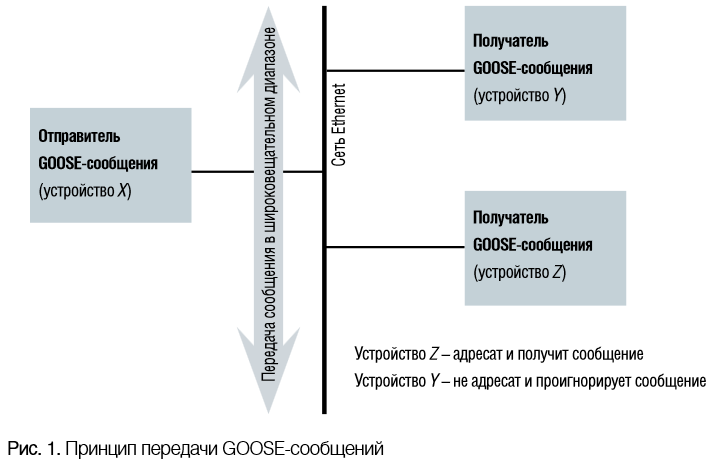
Устройство-отправитель передает по сети Ethernet информацию в широковещательном диапазоне.
В сообщении присутствует адрес отправителя и адреса, по которым осуществляется его передача, а также значение сигнала (например «0» или «1»).
Устройство-получатель получит сообщение, а все остальные устройства его проигнорируют.
Поскольку передача GOOSE-сообщений осуществляется в широковещательном диапазоне, т.е. нескольким адресатам, подтверждение факта получения адресатами сообщения отсутствует. По этой причине передача GOOSE-сообщений в установившемся режиме производится с определенной периодичностью.
При наступлении нового события в системе (например, КЗ и, как следствие, пуска измерительных органов защиты) начинается спонтанная передача сообщения через увеличивающиеся интервалы времени (например, 1 мс, 2 мс, 4 мс и т.д.). Интервалы времени между передаваемыми сообщениями увеличиваются, пока не будет достигнуто предельное значение, определяемое пользователем (например, 50 мс). Далее, до момента наступления нового события в системе, передача будет осуществляется именно с таким периодом. Указанное проиллюстрировано на рис. 2.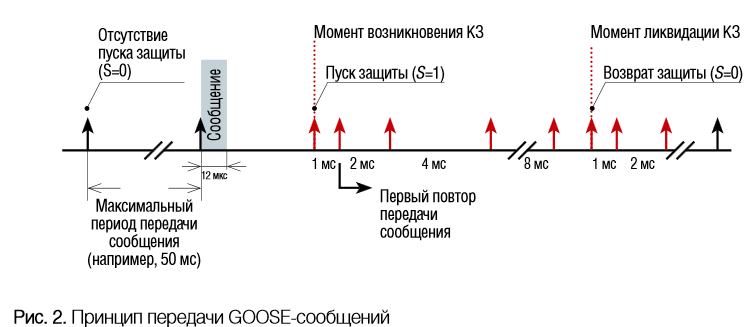
Технология повторной передачи не только гарантирует получение адресатом сообщения, но также обеспечивает контроль исправности линии связи и устройств – любые неисправности будут обнаружены по истечении максимального периода передачи GOOSE-сообщений (с точки зрения эксплуатации практически мгновенно). В случае передачи сигналов традиционным образом неисправность выявляется либо в процессе плановой проверки устройств, либо в случае неправильной работы системы РЗА.
Еще одной особенностью передачи GOOSE-сообщений является использование функций установки приоритетности передачи телеграмм (priority tagging) стандарта Ethernet IEEE 802.3u, которые не используются в других протоколах, в том числе уровня TCP/IP. То есть GOOSE-сообщения идут в обход «нормальных» телеграмм с более высоким приоритетом (см. рис. 3).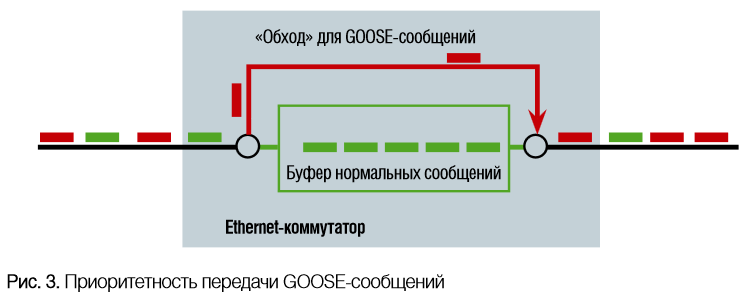
Однако стандарт МЭК 61850 декларирует передачу не только дискретной информации между терминалами РЗА, но и аналоговой. Это означает, что в будущем будет иметься возможность передачи аналоговой информации от ТТ и ТН по цифровым каналам связи. На данный момент готовых решений по передаче аналоговой информации для целей РЗА (в рамках стандарта МЭК 61850) ни один из производителей не предоставляет.
Для того чтобы использовать GOOSE-сообщения для передачи дискретных сигналов между терминалами РЗА необходима достаточная надежность и быстродействие передачи GOOSE-сообщений. Надежность передачи GOOSE-сообщений обеспечивается следующим:- Протокол МЭК 61850 использует Ethernet-сеть, за счет этого выход из строя верхнего уровня АСУ ТП и любого из устройств РЗА не отражается на передаче GOOSE-сообщений оставшихся в работе устройств,
- Терминалы РЗА имеют два независимых Ethernet-порта, при выходе одного из них из строя второй его полностью заменяет,
- Сетевые коммутаторы, к которым подключаются устройства РЗА, соединяются в два независимых «кольца»,
- Разные порты одного терминала РЗА подключаются к разным сетевым коммутаторам, подключенным к разным «кольцам»,
- Каждый сетевой коммутатор имеет дублированное питание от разных источников,
- Во всех устройствах РЗА осуществляется постоянный контроль возможности прохождения каждого сигнала. Это позволяет автоматически определить не только отказы цифровой связи, но и ошибки параметрирования терминалов.
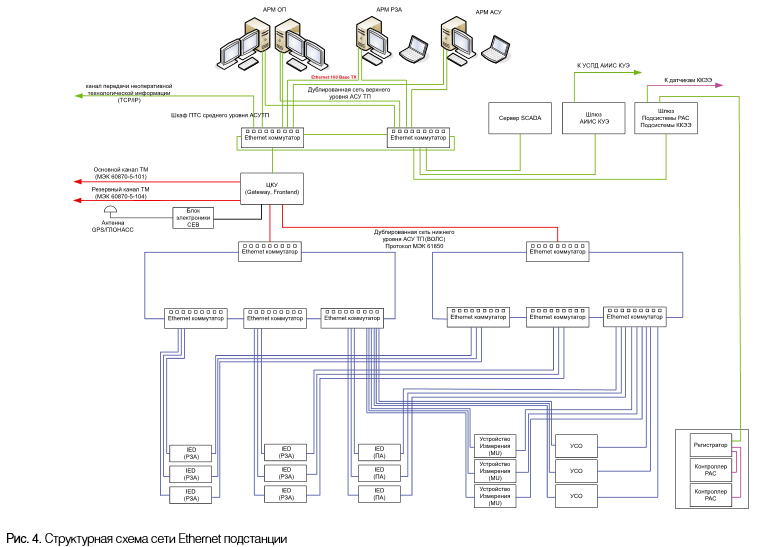
На рис. 4 изображен пример структурной схемы сети Ethernet (100 Мбит/c) подстанции. Отказ в передаче GOOSE-сообщения от одного устройства защиты другому возможен в результате совпадения как минимум двух событий. Например, одновременный отказ двух коммутаторов, к которым подключено одно устройство или одновременный отказ обоих портов одного устройства. Могут быть и более сложные отказы, связанные с одновременным наложением большего количества событий. Таким образом, единичные отказы оборудования не могут привести к отказу передачи GOOSEсообщений. Дополнительно увеличивает надежность то обстоятельство, что даже в случае отказа в передаче GOOSE-сообщения, устройство, принимающее сигнал, выдаст сигнал неисправности, и персонал примет необходимые меры для ее устранения.
Быстродействие.
В соответствии с требованиями стандарта МЭК 61850 передача GOOSE-сообщений должна осуществляться со временем не более 4 мс (для сообщений, требующих быстрой передачи, например, для передачи сигналов срабатывания защит, пусков АПВ и УРОВ и т.п.). Вообще говоря, время передачи зависит от топологии сети, количества устройств в ней, загрузки сети и загрузки вычислительных ресурсов терминалов РЗА, версии операционной системы терминала, коммуникационного модуля, типа центрального процессора терминала, количества коммутаторов и некоторых других аспектов. Поэтому время передачи GOOSE-сообщений должно быть подтверждено опытом эксплуатации.
Используя для передачи дискретных сигналов GOOSE-сообщения необходимо обращать внимание на то обстоятельство, что при использовании аппаратуры некоторых производителей, в случае отказа линии связи, значение передаваемого сигнала может оставаться таким, каким оно было получено в момент приема последнего сообщения.
Однако при отказе связи бывают случаи, когда сигнал должен принимать определенное значение. Например, значение сигнала блокировки МТЗ ввода 6–10 кВ в логике ЛЗШ при отказе связи целесообразно установить в значение «1», чтобы при КЗ на отходящем присоединении не произошло ложного отключения ввода. Так, к примеру, при проектировании терминалов фирмы Siemens изменить значение сигнала при отказе связи возможно с помощью свободно-программируемой CFCлогики (см. рис. 5).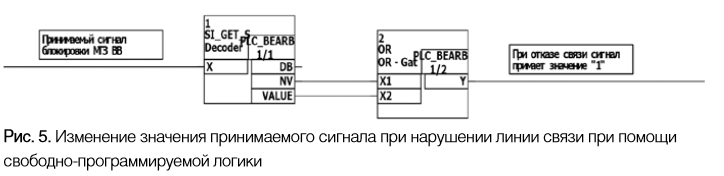
К CFC-блоку SI_GET_STATUS подводится принимаемый сигнал, на выходе блока мы можем получить значение сигнала «Value» и его статус «NV». Если в течение определенного времени не поступит сообщение со значением сигнала, статус сигнала «NV» примет значение «1». Далее статус сигнала и значение сигнала подводятся к элементу «ИЛИ», на выходе которого будет получено значение сигнала при исправности линии связи или «1» при нарушении исправности линии связи. Изменив логику, можно установить значение сигнала равным «0» при обрыве связи.
Использование GOOSE-сообщений предъявляет специальные требования к наладке и эксплуатации устройств РЗА. Во многом процесс наладки становится проще, однако при выводе устройства из работы необходимо следить не только за выводом традиционных цепей, но и не забывать отключать передачу GOOSE-сообщений.
При изменении параметрирования одного устройства РЗА необходимо производить загрузку файла параметров во все устройства, с которыми оно было связано.
В нашей стране имеется опыт внедрения и эксплуатации систем РЗА с передачей дискретных сигналов с использованием GOOSE-сообщений. На первых объектах GOOSE-сообщения использовались ограниченно (ПС 500 кВ «Алюминиевая»).
На ПС 500 кВ «Воронежская» GOOSEсообщения использовались для передачи сигналов пуска УРОВ, пуска АПВ, запрета АПВ, действия УРОВ на отключение смежного элемента, положения коммутационных аппаратов, наличия/отсутствия напряжения, сигналы ЛЗШ, АВР и т.п. Кроме того, на ОРУ 500 кВ и 110 кВ ПС «Воронежская» были установлены полевые терминалы, в которые собиралась информация с коммутационного оборудования и другая дискретная информация с ОРУ (рис. 6). Далее информация с помощью GOOSE-сообщений передавалась в терминалы РЗА, установленные в ОПУ подстанции (рис. 7, 8).
GOOSE-сообщения также были использованы при проектировании уже введенных в эксплуатацию ПС 500 кВ «Бескудниково», ПС 750 кВ «Белый Раст», ПС 330кВ «Княжегубская», ПС 220 кВ «Образцово», ПС 330 кВ «Ржевская». Эта технология применяется и при проектировании строящихся и модернизируемых подстанций ПС 500 кВ «Чагино», ПС 330кВ «Восточная», ПС 330 кВ «Южная», ПС 330 кВ «Центральная», ПС
330 кВ «Завод Ильич» и многих других.
Основные преимущества использования GOOSE-сообщений:- позволяет снизить количество кабелей вторичной коммутации на ПС;
- обеспечивает лучшую помехозащищенность канала связи;
- позволяет снизить время монтажных и пусконаладочных работ;
- исключает проблему излишнего срабатывания дискретных входов терминалов из-за замыканий на землю в цепях оперативного постоянного тока;
- убирает зависимость количества передаваемых сигналов от количества дискретных входов и выходных реле терминалов;
- обеспечивает возможность реконструкции и изменения связей между устройствами РЗА без прокладки дополнительных кабельных связей и повторного монтажа в шкафах;
- позволяет использовать МП терминалы РЗА с меньшим количеством входов и выходов (уменьшение габаритов и стоимости устройства);
- позволяет контролировать возможность прохождения сигнала (увеличивается надежность).
Безусловно, для окончательных выводов должен появиться достаточный опыт эксплуатации. В настоящее время большинство производителей устройств РЗА заявили о возможности использования GOOSEсообщений. Стандарт МЭК 61850 определяет передачу GOOSE-сообщений между терминалами разных производителей. Использование GOOSE-сообщений для передачи дискретных сигналов – это качественный скачок в развитии систем РЗА. С развитием стандарта МЭК 61850, переходом на Ethernet 1 Гбит/сек, с появлением новых цифровых ТТ и ТН, новых выключателей с возможностью подключения их блока управления к шине процесса МЭК 61850, эффективность использования GOOSE-сообщений намного увеличится. Облик будущих подстанций представляется с минимальным количеством контрольных кабелей, с передачей всех сообщений между устройствами РЗА, ТТ, ТН, коммутационными аппаратами через цифровую сеть. Устройства РЗА будут иметь минимальное количество выходных реле и дискретных входов
[ http://romvchvlcomm.pbworks.com/f/goosepaper1.pdf]
В стандарте определены два способа передачи данных напрямую между устройствами: GOOSE и GSSE. Это тоже пример наличия двух способов для реализации одной функции. GOOSE - более новый способ передачи сообщений, разработан специально для МЭК 61850. Способ передачи сообщений GSSE ранее присутствовал в стандарте UCA 2.0, являющимся одним из предшественников МЭК 61850. По сравнению с GSSE, GOOSE имеет более простой формат (Ethernet против стека OSI протоколов) и возможность передачи различных типов данных. Вероятно, способ GSSE включили в МЭК 61850 для того, чтобы производители, имеющие в своих устройствах протокол UCA 2.0, могли сразу декларировать соответствие МЭК 61850. В настоящее время все производители используют только GOOSE для передачи сообщений между устройствами.
Для выбора списка передаваемых данных в GOOSE, как и в отчѐтах, используются наборы данных. Однако тут требования уже другие. Время обработки GOOSE-сообщений должно быть минимальным, поэтому логично передавать наиболее простые типы данных. Обычно передаѐтся само значение сигнала и в некоторых случаях добавляется поле качества. Метка времени обычно включается в набор данных.
...
В устройствах серии БЭ2704 в передаваемых GOOSE-сообщениях содержатся данные типа boolean. Приниматься могут данные типа boolean, dbpos, integer.
Устоявшаяся тенденция существует только для передачи дискретной информации. Аналоговые данные пока передают немногие производители, и поэтому устоявшаяся тенденция в передаче аналоговой информации в данный момент отсутствует.
[ Источник]
Тематики
Синонимы
EN
Русско-английский словарь нормативно-технической терминологии > широковещательное объектно-ориентированное сообщение о событии на подстанции
-
8 договор
1) (между государствами) treaty, pact, convention; accord амер.аннулировать договор — to abrogate / to cancel / to rescind / to repudiate a treaty
вступить в переговоры с целью адаптации договора к новым условиям — to negotiate the adaptation of a treaty to new conditions
выполнять договор — to implement / to observe / to abide by a treaty
завершить / закончить работу по составлению договора — to complete / to consummate a treaty
заключить договор — to conclude / to effect / to make / to enter into / to sign a treaty
заключить договор на ограниченный период времени — to conclude a treaty for a limited period of time
зарегистрировать / регистрировать договор — to register a treaty
зарегистрировать договор в Секретариате Организации Объединённых Наций — to register the treaty with the Secretariat of the United Nations
навязать кабальный / неравноправный договор — to impose an enslaving / inequal treaty (on, upon)
нарушить договор — to transgress / to violate a treaty; to break / to infringe a contract
представить договор для одобрения / утверждения — to submit a treaty for approval
придавать обязывающую силу договору, сделать договор обязывающим — to impart the binding force to a treaty, to make a treaty binding
признать договор недействительным — to declare a treaty invalid / null / void
присоединиться к договору (уже вступившему в силу) — to accede to / to join / to adhere to a treaty, to become a party to a treaty
пролонгировать договор, продлить действие договора — to prolong a treaty
ратифицировать договор — to confirm / to ratify a treaty
договор не может быть ратифицирован лишь в какой-л. части — the treaty cannot be ratified in part
договоры несовместимы друг с другом — the treaties are inconsistent with each other; договор остаётся в действии / в силе the treaty continues in operation
договор предусматривает, что... — the treaty stipulates that..
договор, срок которого истёк — the treaty which has expired
бессрочный договор — treaty for an indefinite term, permanent / undated treaty
военный договор — military agreement / treaty
гарантийный договор — contract of indemnity, guarantee treaty, treaty of guarantee
дружественный договор между отдельными лицами / партиями / правительствами — concordat
локальный / локализованный договор — localized treaty
мирный договор — peace treaty, treaty of peace
многосторонний договор о контроле над вооружением и разоружении — multilateral treaty on arms control and disarmament
многосторонний сбалансированный и полностью контролируемый договор — multilateral balanced and fully verified treaty
неравноправный договор — inequitable / unequal treaty
открытый договор, договор, открытый для подписания — open treaty
равноправный договор — equitable / nondiscriminatory treaty
ранее существовавший договор — former / pre-existing treaty
секретный / тайный договор — secret covenant / treaty
союзный договор — treaty of alliance / union
торговый договор — trade / commercial treaty
трёхсторонний договор — triangular / trilateral / tripartite treaty
устный договор — parol / oral treaty
аннулирование договора — abrogation / cancellation of a treaty
в соответствии с буквой и духом договора — in accordance / on compliance with the letter and spirit of the treaty
вступление договора в силу — entry into force of a treaty, coming of a treaty into force
выполнение договора — execution / fulfilment / implementation of a treaty
добросовестное выполнение договора — fulfilment / implementation of a treaty in good faith
обеспечить полное выполнение всех положений и пониманий договора — to achieve the full implementation of all the provisions and understandings of the treaty
проверять выполнение договора — to check up on one's compliance with the treaty, to review the operation of the treaty
проверка выполнения договора — verification / review of a treaty
средства, обеспечивающие выполнение договора — means to secure the performance of a treaty
выход из договора — pull-out / withdrawal from a treaty
выход из договора / отказ от договора с уведомлением — withdrawal from a treaty with notice
действие договора — effect / operation of a treaty
прекратить действие договора — to terminate (the operation of) a treaty, to bring a treaty to an end
прекращение действия договора с согласия участников — termination of a treaty by consent of the parties
прекращение действия договора (вследствие истечения его срока или в результате возникновения определённого оговорённого условия) — expiration of a treaty
продлить срок действия договора — to prolong the time of operation of a treaty, to extend a treaty
основание для оспаривания действительности договора — ground for impeaching the validity of a treaty
денонсация / денонсирование договора — denunciation of a treaty
договоры государств-участников, заключённые до создания сообщества с третьими странами — pre-community treaties of member-states with third countries
договоры, заключённые до получения независимости — pre-independence treaties
договор, заключённый страной пребывания — treaty concluded by the country of residence
договор, запрещающий все испытания ядерного оружия — treaty banning all nuclear weapon tests
договор, который не предусматривает денонсации или отказа — the treaty which does not provide for denunciation or withdrawal
договор, не имеющий законной силы — invalid treaty
договор, не направленный против третьей стороны — nondiscriminatory treaty
договор, не требующий особых законодательных мероприятий — self-executing treaty
договор безопасности — security treaty / pact
"Д. о взаимном неприменении силы и поддержании отношений мира между государствами" — "Treaty on Mutual Non-Use of Force and Maintenance of Peaceful Relations among States"
договор о взаимопомощи — treaty of mutual assistance, mutual assistance pact
договор о всеобъемлющем запрещении испытаний ядерного оружия — comprehensive test ban treaty (CTB treaty)
договор о выдаче преступника — extradition treaty, treaty of extradition
договор о гарантиях — guarantee treaty, treaty of guarantee
договор о дружбе, добрососедстве и сотрудничестве — treaty of friendship, neigh-bourliness and cooperation
договор о дружбе, сотрудничестве и взаимопомощи — treaty of friendship, cooperation and mutual assistance
"Д. о запрещении испытаний ядерного оружия в атмосфере, в космическом пространстве и под водой" — "Treaty Banning Nuclear Weapon Tests in the Atmosphere, in Outer Space and Under Water"
договор о запрещении подземных испытаний ядерного оружия — treaty banning underground nuclear-weapon tests
договор о зоне, свободной от ядерного оружия — nuclear-weapon-free-zone treaty
договор о мире, дружбе и сотрудничестве — treaty of peace, friendship and cooperation
договор о нейтралитете — treaty of neutrality, neutrality treaty
договор о ненападении — nonaggression pact / treaty
договор о торговле и судоходстве / мореплавании — treaty of / on commerce and navigation
Договор об обычных вооружённых силах в Европе — Agreement on Conventional Forces in Europe, CFE
Договор об ограничении стратегических вооружений / ОСВ — Strategic Arms Limitation Treaty, SALT
договор, открытый для присоединения третьих государств — treaty opened to accession of third states
договор по противоракетной обороне, ПРО — Anti-Ballistic Missile Treaty (ABM treaty)
не выходить из договора по ПРО в течение согласованного времени — not to withdraw from the ABM treaty for a specified period of time
Договор по ракетам средней и меньшей дальности, РСМД — Treaty on the Elimination of Intermediate-Range and Shorter-Range Missiles
договор, подлежащий выполнению в будущем — executory treaty
договор, предусматривающий аналогичные / равные / одинаковые привилегии — treaty providing for reciprocal privileges
договор, принятый в рамках международной организации — treaty adopted within an international organization
договор с внесённой / внесёнными в него поправкой / поправками — treaty as amended
договоры, устанавливающие свободу судоходства на международных водных путях или реках — treaties according freedom of navigation in international waterways or rivers
договор, устаревший в силу тех или иных событий — treaty outmoded by events
заключение договора — conclusion / formation of a treaty, treaty-making
исполнение договора — execution of a treaty / contract
нарушение договора — breach / infringement / violation of a treaty
грубое нарушение договора — gross / flagrant violation of a treaty
несоблюдение договора — noncompliance with / nonobservance of a treaty
быть несовместимым с объектом / целями договора — to be incompatible with the object and purpose of a treaty
обязательная сила / обязательность договоров — binding / obligatory force / obligation of treaties
отказ от договора — repudiation / renunciation of a treaty
полный свод договоров, заключённых страной пребывания — complete set of treaties concluded by the country of residence
поправка к договору — amendment to a treaty, amending clause
порядок / система размещения материала в договоре — arrangement of a treaty
продление / пролонгация договора — clause of a treaty
спорные пункты договора — controversial provisions of a treaty, contentious clauses in a treaty
стороны, подписавшие договор — parties to a treaty
сторона, связанная договором — party bound by a treaty
разработать текст договора — to draft / to frame the text of a treaty
расположение / структура текста договора — arrangement of the text of a treaty
условия договора — stipulations / terms of a treaty
контролировать выполнение условий договора — to supervise the observance of the treaty provisions / terms
со всеми вытекающими из договора правилами и обязанностями — with all the rights and duties arising from the treaty
2) (соглашение, контракт) agreement, contract, concord -
9 техническое состояние объекта
техническое состояние объекта
техническое состояние
Состояние, которое характеризуется в определенный момент времени, при определенных условиях внешней среды, значениями параметров, установленных технической документацией на объект.
К факторам, под воздействием которых изменяется техническое состояние объекта, можно отнести действия климатических условий, старение с течением времени, операции регулировки и настройки в ходе изготовления или ремонта, замену отказавших элементов и т.п.
Об изменении технического состояния объекта судят по значениям диагностических (контролируемых) параметров, позволяющих определить техническое состояние объекта без его разборки.
[ ГОСТ 20911-89]
[СТО Газпром РД 2.5-141-2005]Тематики
Синонимы
EN
Русско-английский словарь нормативно-технической терминологии > техническое состояние объекта
-
10 В объектно-ориентированной модели зависящие от сост
General subject: In an object-oriented model, the state-dependent aspects of a system are defined by means of one or more finite state machines, where each finite state machine is encapsulated inside its own objectУниверсальный русско-английский словарь > В объектно-ориентированной модели зависящие от сост
-
11 установившийся режим функционирования
установившийся режим функционирования
Функционирование объекта, при котором выбранные характеристики выходного состояния этого объекта в течение достаточно большого интервала времени изменяются в пренебрежимо малом диапазоне.
Примечание
Выбранными характеристиками выходного состояния могут быть: значения координат, скорости их изменения, амплитуды их колебаний, соотношения значений координат и т. п.
[Сборник рекомендуемых терминов. Выпуск 107. Теория управления.
Академия наук СССР. Комитет научно-технической терминологии. 1984 г.]Тематики
- автоматизация, основные понятия
EN
Русско-английский словарь нормативно-технической терминологии > установившийся режим функционирования
-
12 положение
1. с. location, position2. с. condition, state3. с. postulate, proposition, statementСинонимический ряд:1. поза (сущ.) поза2. тезис (сущ.) теза; тезис; тезу -
13 общественное право
общественное право
—
[ http://www.eionet.europa.eu/gemet/alphabetic?langcode=en]EN
public law
A general classification of law, consisting generally of constitutional, administrative, criminal and international law, concerned with the organization of the state, the relations between the state and the people who compose it, the responsibilities of public officers to the state, to each other, and to private persons, and the relations of states to one other. The branch or department of law which is concerned with the state in its political or sovereign capacity, including constitutional and administrative law, and with the definition, regulation, and enforcement of rights in cases where the state is regarded as the subject of the right or object of the duty, - including criminal law and criminal procedure, - and the law of the state, considered in its quasi private personality, i.e., as capable of holding or exercising rights, or acquiring and dealing with property, in the character of an individual. (Source: WESTS)
[http://www.eionet.europa.eu/gemet/alphabetic?langcode=en]Тематики
EN
DE
FR
Русско-немецкий словарь нормативно-технической терминологии > общественное право
-
14 общественное право
общественное право
—
[ http://www.eionet.europa.eu/gemet/alphabetic?langcode=en]EN
public law
A general classification of law, consisting generally of constitutional, administrative, criminal and international law, concerned with the organization of the state, the relations between the state and the people who compose it, the responsibilities of public officers to the state, to each other, and to private persons, and the relations of states to one other. The branch or department of law which is concerned with the state in its political or sovereign capacity, including constitutional and administrative law, and with the definition, regulation, and enforcement of rights in cases where the state is regarded as the subject of the right or object of the duty, - including criminal law and criminal procedure, - and the law of the state, considered in its quasi private personality, i.e., as capable of holding or exercising rights, or acquiring and dealing with property, in the character of an individual. (Source: WESTS)
[http://www.eionet.europa.eu/gemet/alphabetic?langcode=en]Тематики
EN
DE
FR
Русско-английский словарь нормативно-технической терминологии > общественное право
-
15 общественное право
общественное право
—
[ http://www.eionet.europa.eu/gemet/alphabetic?langcode=en]EN
public law
A general classification of law, consisting generally of constitutional, administrative, criminal and international law, concerned with the organization of the state, the relations between the state and the people who compose it, the responsibilities of public officers to the state, to each other, and to private persons, and the relations of states to one other. The branch or department of law which is concerned with the state in its political or sovereign capacity, including constitutional and administrative law, and with the definition, regulation, and enforcement of rights in cases where the state is regarded as the subject of the right or object of the duty, - including criminal law and criminal procedure, - and the law of the state, considered in its quasi private personality, i.e., as capable of holding or exercising rights, or acquiring and dealing with property, in the character of an individual. (Source: WESTS)
[http://www.eionet.europa.eu/gemet/alphabetic?langcode=en]Тематики
EN
DE
FR
Русско-французский словарь нормативно-технической терминологии > общественное право
-
16 право прав·о
юр.аннулировать права — to annul / to nullify rights
восстанавливать в правах — to rehabilitate (smb.)
давать право одному государству совершать действия на территории другого государства — to give to a state the right to perform certain acts on the territory of another state
дать (кому-л.) право — to give (smb.) a title
затрагивать (чьи-л.) права — to involve (smb.'s) rights
злоупотреблять (своими) правами — to abuse the rights
иметь право — to have / to possess the right (to), to be entitled (to), to be eligible (for); to be vested with the right
иметь право исповедовать любую религию или не исповедовать никакой — to have the right to profess or not to profess any religion
иметь право стать членом (какой-л. организации) — to be eligible for membership
лишиться / утрачивать права — to forfeit
наносить ущерб (чьим-л.) правам — to prejudice (smb.'s) rights
не иметь права вмешиваться в обсуждение (какого-л.) вопроса — to have no say in the matter, not to be entitled to the discussion
обладать правами — to enjoy / to have rights
обрести право — to qualify (for)
оговаривать право в отношении (чего-л.) — to reserve the right with regard (to smth.)
ограничивать права — to curtail / to restrict (smb.'s) rights
оспаривать право — to dispute / to contest a right
оставить (за собой) право сделать (что-л.) — to reserve the right to do (smth.)
осуществлять (свои) права — to exercise (one's) rights
отказать (кому-л.) в праве — to deny (smb.) the right
отказаться от (своего) права — to renounce / to resign / to abandon / to surrender (one's) right (to)
отказаться от права выступить — to forgo / to waive one's right to speak
отстаивать (свои) права — to assert / to stand upon (one's) rights
подтвердить права (жителей) — to underpin the rights (of inhabitants)
пользоваться правами — to exercise / to enjoy one's rights поступаться (своим) правом to waive (one's) right
посягать на (чьи-л.) права — to invade (smb's) rights, to infringe on / upon (smb.'s) rights
предоставлять права — to confer rights (upon), to grant / to accord / to give rights (to), to entitle, to enable, to empower
предоставлять (кому-л.) право сделать что-л. (преим. о законодательстве) — to enable (smb.) to do smth.
присваивать (себе) право — to arrogate (to oneself) a right
расширять права — to broaden / to expand the rights
реализовать (своё) право — to exercise (one's) right
сохранять (за собой) право сделать что-л. — to reserve the right (to do smth.)
требовать причитающегося по праву — to claim a / one's right
уважать права и законные интересы (других) лиц — to respect the rights and lawful interests of (other) persons
уравнивать в право ах — to give / to grand equal rights (to smb.), to equalize (smb.) in rights
урезать права — to curtail (smb.'s) rights
ущемлять права — to derogate from (smb.'s) right
ущемлять законные права и интересы — to infringe (on) ligitimate rights and interests
"бумажное право" (право, существующее на бумаге) — paper title
естественное право — natural law / right
законное право — legitimate right, valid title
борьба за законные права — struggle for (one's) legitimate rights
избирательное право — vote, electoral right, suffrage, elective franchise, electorship
всеобщее, равное и прямое избирательное право при тайном голосовании — universal, equal and direct suffrage by secret ballot
лишённый избирательного права — voteless, nonvoter
избирательное право для женщин — female / women's suffrage
лишение избирательных прав — deprivation of electoral rights, disenfranchisement
имеющий право быть избранным — electable, eligible
имеющий право выбирать — elective, eligible
имеющий право выдвижения собственной кандидатуры или избрания самого себя (на какой-л. пост, в члены организации) — self-elective
имущественные права — property rights, vested interests
исключительное право — exclusive / sole / prerogative right, monopoly, prerogative, absolute title
исключительное право на учреждение предприятия / фирмы — exclusive right of establishment
монопольное право — exclusive / monopoly / sole right
неотъемлемое право — inalienable / inherent / undeniable right
облекающий правом (преим. о законе) — enabling
общее / совместное право — right of common
основные права — basic / fundamental rights
особое право, предоставленное правительством или монархом — franchise
лишать политических прав — to denude / to deprive (smb.) of political rights
преимущественное право — preference, priority / underlying, preferential right, right of priority
признанные права — acquired / vested rights
на равных правах — enjoying / exercising equal rights
предоставить специальные права — to confer (on smb.) special rights
осуществлять (свои) суверенные права — to exercise (one's) sovereign rights
феодальное право ист. — feudal law
защита прав — defence / protection of rights
коллизия права (противоречие между нормами различных правовых систем по одному и тому же вопросу) — conflict of laws
лицо, имеющее право на обратный переход к нему имущества — reversioner
лица, ограниченные в праве передвижения — restrictees
лицо, отказавшееся от (каких-либо) прав в пользу другого лица — releasor
лицо, получившее право на возмещение ущерба — recoveror
нарушение / ущемление прав — infringement / violation of rights
отказ от прав — abandonment of rights, quitclaim
положение, принадлежащее по праву — rightful position
право ангарии, право воюющей стороны на захват — right of angary
право беспрепятственного / мирного прохода — right of innocent passage
право вето — right of veto, veto power, negative voice
право владения, пользования и распоряжения — right of possession, enjoyment and disposal
право выбирать (свой собственный) путь (развития) — right of nations to choose their own path / way (of development)
право выгрузки пассажиров, багажа, грузов и почты — right to discharge passengers, baggage, cargo and mail
право выезда / выхода — egress
право, выработанное судами — judge-made law
право, вытекающее из (факта) владения — title by possession
права, вытекающие из данного договора — rights under the treaty
право вышестоящего суда пересмотреть приговор или решение нижестоящего суда — appellate jurisdiction
право голоса / участия в выборах / голосовании — voting right, franchise one's right to vote
лишать права голоса — to exclude (smb.) from the poll, to deprive of the right to vote, to disfranchise
лишать выборщика права голоса — to disqualify an elector, to disfranchise
право государств на суверенитет над своими природными ресурсами — right of nations of sovereignty over their natural resources
равные права граждан всех рас и национальностей — equal rights of citizens of all races and nationalities
права заимствования / на получение кредита (в МВФ) — drawing rights (in IMF)
специальные права заимствования, СПЗ — special drawing rights, SDR
право заключать коллективные договоры — right to collective bargaining, right to conclude collective agreements
право законодательной инициативы — right of legislative initiative, power to initiate legislation
социально-экономические, политические и личные права и свободы — social, economic, political and personal rights and freedoms
право инспекции / осмотра — right of inspection
право мирного прохода через территориальные воды — freedom of inoffensive passage through the maritime belt
право на вмешательство / на интервенцию — right of intervention
право на возвращение (своих) природных ресурсов — right to reclaim (one's) natural resources
право на выход из состава участников (соглашения, договора и т.п.) — right of withdrawal
право на гражданство — right to citizenship / nationality
право на домовую церковь (для посла) / свободного отправления религиозного культа в особом помещении посольства или миссии — right of Chapel
право на жизнь, свободу и личную неприкосновенность — right to life, liberty and security of person
права на интеллектуальную и промышленную собственность — intellectual and industrial property rights
право на материальное обеспечение в старости в случае болезни и потери трудоспособности — right to material security in old age, sickness and disability
право на национализацию или передачу владения своим гражданам — right to nationalization or transfer of ownership to its nationals
право на ответ / на ответное слово — right of reply
используя право на ответ / в порядке осуществления права на ответ — in exercise of (one's) right of reply
отказаться от права на ответ — to waive (one's) right to reply
право на получение информации (журналистами) / право быть осведомлённым — right to know разг.
право на разработку минеральных ресурсов / полезных ископаемых — mineral rights
права на репатриацию иностранных капиталовложений / прибылей — repatriation right
право на самооборону — right of / to self-defence
право на свободу убеждений и свободное их выражение / свободу слова — right to freedom of opinion and expression
право на связь / на использование связи — right of communication
право на социальное обеспечение — right to social security / insurance
право на существование — right to exist, right of existence
иметь право на что-л. (в силу собственных заслуг, способностей, создавшегося положения) — in one's own right
право навигации / судоходства — navigation right
право народов на свободное и независимое развитие — right of nations to free and independent development
право наследования — right of succession / to inherit
право наций на самоопределение вплоть до государственного отделения — right of nations to self-determination up to and including separation
право обжаловать действия должностных лиц — the right to lodge a complaint against the actions of officials
право, основанное на давности (его использования) — prescriptive right
права, осуществляемые (по чьему-л.) полномочию — vicarious power / authority
права, относящиеся к предоставлению убежища — rights relating to asylum
право погрузки пассажиров, багажа, грузов и почты — right to pick up passengers, baggage, cargo and mail
право покидать любую страну, включая свою собственную, и возвращаться в свою страну — right to leave any country including one's own and to return to one's country
право по рождению / в силу происхождения — birthright
право посольства / представительства — right of legation
право, признанное судом справедливости — equities
право принимать и назначать дипломатических представителей — right of reception and mission of diplomatic envoys
право принимать пассажиров, направляющихся на территорию (какого-л.) государства — privilege to take on passengers for the territory of a state
право проезда / прохода — right of passage
право рыболовства — right of fishery / fishing
право свободно выбирать (себе) местожительство — right to freedom of residence
право свободного доступа (к чему-л.) — freedom of access (to smth.)
право собственности — title, property right, right of ownership
права собственности или квазисобственности — proprietary or quasi-proprietary rights
неоспоримое право собственности — marketable / merchantable / good title
право собственности, приобретённое завладением — title by occupancy
право ссылаться на основание недействительности договора — right to invoke a ground for invalidating a treaty
право ссылаться на основание прекращения договора — right to invoke a ground for terminating a treaty
право ссылаться на основание приостановления действия договора — right to invoke a ground for suspending the operation of a treaty
право транзита / транзитного прохода — right of transit
право убежища — right of asylum, rights of sanctuary, sanctuary rights
права человека — human rights, rights of mankind
защита прав человека — defence / protection of human rights
нарушение прав человека — repsession / supression / violation of human rights
право (на осуществление) юрисдикции — right of jurisdiction
утрата права на... — loss of a right to...
2) мн. (свидетельство) licence3) (совокупность законов и постановлений) law, ruleвнутригосударственное право — national law, municipal jurisprudence
государственное право — state / political / public / constitutional law
нарушения государственных или общественных прав и интересов — public wrongs
применяемое в вооружённых конфликтах гуманитарное право — humanitarian rules relating to armed conflicts
договорное право — law of treaties, contract law
дополнительное, субсидиарное право — appendant
каноническое право — canon law, the Canon
космическое право — outer space / cosmic law
крепостное право ист. — serfdom
кулачное право, право сильного — fist law
международное право — international law, law of nations
игнорировать общепризнанные нормы международного права — to disregard generally recognized norms of international law
несовместимость с нормами международного права — incompatibility with the norms / rules of international law
морское право — law of the sea, maritime / naval law
морское призовое право — maritime / naval prize
общее / обычное право — common / customary / consuetudinary law
прецедентное право — law of precedent, case law
торговое право — merchant / commercial law, law-merchant
уголовное право — criminal / penal law
нарушение / несоблюдение норм права — contempt of the law
-
17 диаграмма конечных ав
Универсальный русско-английский словарь > диаграмма конечных ав
-
18 не достичь цели
1) General subject: be balked of purpose, fail in one's object, get nowhere, miss, miss the mark (напр, the state misses the mark in its attempt to capture windfall oil revenues), succeed in one's object, to be balked of (one's) purpose, to be baulked of (one's) purpose, miss fire, miss mark2) Diplomatic term: fall short3) Jargon: drop the ball4) Mass media: fail to do the trick (англ. цитата приводится из статьи в газете New York Times)5) Makarov: fall short of targets -
19 объект–координатор: объект, который принимает решения об упорядочении событий для набора взаи
Универсальный русско-английский словарь > объект–координатор: объект, который принимает решения об упорядочении событий для набора взаи
-
20 анзац
1) <math.> initial object
2) initial-state manifold
См. также в других словарях:
Object Process Methodology — (OPM) is an approach to designing information systems by depicting them using object models and process models. OPM was conceived and developed by Prof. Dov Dori, at the Technion – Israel Institute of Technology. A paper that first presented… … Wikipedia
Object-oriented analysis and design — (OOAD) is a software engineering approach that models a system as a group of interacting objects. Each object represents some entity of interest in the system being modeled, and is characterised by its class, its state (data elements), and its… … Wikipedia
Object Manager (Windows) — Object Manager in Windows, categorized hierarchically using namespaces Object Manager (internally called Ob) is a subsystem implemented as part of the Windows Executive which manages Windows resources. Each resource, which are surfaced as logical … Wikipedia
object — ob·ject 1 / äb jikt/ n 1: something toward which thought, feeling, or action is directed see also natural object 2: the purpose or goal of something; esp in the civil law of Louisiana: the purpose for which a contract or obligation is formed… … Law dictionary
Object Management Group — Formation 1989 Headquarters Needham, Massachusetts Website … Wikipedia
Object-oriented ontology — (OOO) is a metaphysical movement that rejects the privileging of human existence over the existence of nonhuman objects.[1] Specifically, object oriented ontology opposes the anthropocentrism of Immanuel Kant s Copernican Revolution, whereby… … Wikipedia
Object Action Complex — Object Action Complexes (OACs) are proposed as a universal representation enabling efficient planning and execution of purposeful action at all levels of a cognitive architecture (Kruger 2009, Worgotter 2008, Geib 2006, Piater 2009). OACs combine … Wikipedia
object — [äb′jikt, äbjekt; ] for v. [ əb jekt′, äbjekt′] n. [ME < ML objectum, something thrown in the way < L objectus, a casting before, that which appears, orig. pp. of objicere < ob (see OB ) + jacere, to throw: see JET1] 1. a thing that can… … English World dictionary
State of New York — State of New York † Catholic Encyclopedia ► State of New York One of the thirteen colonies of Great Britain, which on 4 July, 1776, adopted the Declaration of Independence and became the United States of America. BOUNDARIES AND… … Catholic encyclopedia
State diagram — State diagrams is a diagram used in the field of computer science, representing the behavior of a system, which is composed of a finite number of states. There are many forms of state diagrams, which differ slightly and have different semantics.… … Wikipedia
State and Revolution — is a book written by Vladimir Lenin in August and September of 1917. It describes the role that the state plays in society along with the necessity of proletarian revolution. Written for a Marxist audience, Lenin spends much of the pamphlet… … Wikipedia
